Skip to main content
Calculus
My Course
Learn
Exam Prep
AI Tutor
Study Guides
Textbook Solutions
Flashcards
Explore
Try the app
My Course
Learn
Exam Prep
AI Tutor
Study Guides
Textbook Solutions
Flashcards
Explore
Try the app
Back
Convergence Tests quiz
You can tap to flip the card.
What is the formula for the sequence discussed in the lesson?
You can tap to flip the card.
👆
What is the formula for the sequence discussed in the lesson?
The formula is a_n = n^2 × (n-1)!
Track progress
Control buttons has been changed to "navigation" mode.
1/15
Related flashcards
Related practice
Recommended videos
Convergence Tests definitions
Convergence Tests
15 Terms
Convergence Tests
14. Sequences & Series
5 problems
Topic
Jonathan
Series
14. Sequences & Series
5 problems
Topic
Ernest
14. Sequences & Series
4 topics
12 problems
Chapter
Ernest
Guided course
05:35
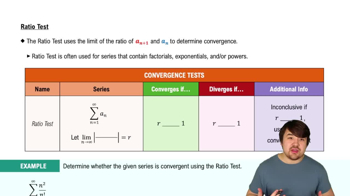
Ratio Test
532
views
12
rank
Guided course
09:25
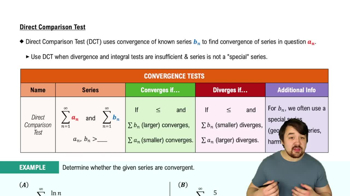
Direct Comparison Test
661
views
14
rank
Guided course
10:07
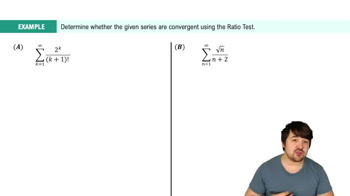
Ratio Test Example 1
359
views
10
rank
Terms in this set (15)
Hide definitions
What is the formula for the sequence discussed in the lesson?
The formula is a_n = n^2 × (n-1)!
How do you find the first term of the sequence a_n = n^2 × (n-1)!?
Plug in n = 1 to get a_1 = 1^2 × 0! = 1 × 1 = 1.
What is the value of zero factorial (0!)?
Zero factorial is defined as 1.
Calculate the second term of the sequence a_n = n^2 × (n-1)!.
a_2 = 2^2 × 1! = 4 × 1 = 4.
What is the value of one factorial (1!)?
One factorial is 1.
How do you calculate the third term of the sequence a_n = n^2 × (n-1)!?
Plug in n = 3 to get a_3 = 3^2 × 2! = 9 × 2 = 18.
What is the value of two factorial (2!)?
Two factorial is 2 × 1 = 2.
Calculate the fourth term of the sequence a_n = n^2 × (n-1)!.
a_4 = 4^2 × 3! = 16 × 6 = 96.
What is the value of three factorial (3!)?
Three factorial is 3 × 2 × 1 = 6.
List the first four terms of the sequence a_n = n^2 × (n-1)!.
The first four terms are 1, 4, 18, and 96.
Is it acceptable to have a factorial in a sequence formula?
Yes, it is perfectly fine to have a factorial in a sequence.
What operation do you perform first when evaluating a_n = n^2 × (n-1)! for a given n?
First, calculate n^2, then multiply by (n-1) factorial.
Why is understanding factorials important in sequences?
Understanding factorials is crucial for grasping concepts in combinatorics and probability.
What do you do if you encounter (n-1)! in a sequence formula?
You substitute n-1 for n, then compute the factorial of that value.
How do you continue the sequence a_n = n^2 × (n-1)! beyond the first four terms?
You keep plugging in higher values of n into the formula to find subsequent terms.
 BackBack
 05:35
05:35