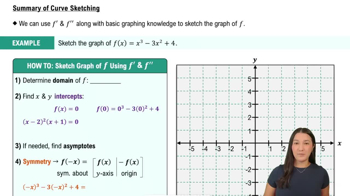
What is the domain of the function f(x) = x^3 - 3x^2 + 4?
The domain is all real numbers, from negative infinity to positive infinity.
How do you find the x-intercepts of a polynomial function?
Set the function equal to zero and solve for x, often by factoring the polynomial.
What is the y-intercept of f(x) = x^3 - 3x^2 + 4?
The y-intercept is 4, found by evaluating f(0).
Does the function f(x) = x^3 - 3x^2 + 4 have any asymptotes?
No, this polynomial function does not have any asymptotes.
How do you test a function for symmetry?
Plug in -x for x and compare the result to the original function to check for even or odd symmetry.
What does the sign of the first derivative tell you about a function?
It tells you whether the function is increasing (positive) or decreasing (negative) on an interval.
How do you find critical points of a function?
Set the first derivative equal to zero or find where it does not exist, then solve for x.
What are the critical points of f(x) = x^3 - 3x^2 + 4?
The critical points are x = 0 and x = 2.
On which intervals is f(x) = x^3 - 3x^2 + 4 increasing?
It is increasing on (-∞, 0) and (2, ∞).
How do you determine where a function is concave up or concave down?
Use the sign of the second derivative: positive means concave up, negative means concave down.
What is the inflection point of f(x) = x^3 - 3x^2 + 4?
The inflection point is at x = 1, where the concavity changes.
How do you use the first derivative test to find local extrema?
Check where the sign of the first derivative changes at critical points to identify local maxima or minima.
Where does f(x) = x^3 - 3x^2 + 4 have a local maximum?
There is a local maximum at x = 0.
Where does f(x) = x^3 - 3x^2 + 4 have a local minimum?
There is a local minimum at x = 2.
What is the general process for sketching the graph of a function using calculus?
Analyze the domain, intercepts, asymptotes, and symmetry, then use the first and second derivatives to find intervals of increase/decrease, concavity, and local extrema.
 Back
Back
 11:41
11:41