Skip to main content
Calculus
My Course
Learn
Exam Prep
AI Tutor
Study Guides
Textbook Solutions
Flashcards
Explore
Try the app
My Course
Learn
Exam Prep
AI Tutor
Study Guides
Textbook Solutions
Flashcards
Explore
Try the app
Back
Exponent rules definitions
You can tap to flip the card.
Exponent
You can tap to flip the card.
👆
Exponent
A small raised number indicating how many times a base is multiplied by itself in an expression.
Track progress
Control buttons has been changed to "navigation" mode.
1/15
Related flashcards
Related practice
Recommended videos
Exponent rules quiz
Exponent rules
15 Terms
Exponent rules
0. Functions
5 problems
Topic
Ernest
Exponential Functions
0. Functions
3 problems
Topic
Ernest
0. Functions - Part 1 of 2
7 topics
14 problems
Chapter
Patrick
0. Functions - Part 2 of 2
8 topics
12 problems
Chapter
David-Paige
7:39
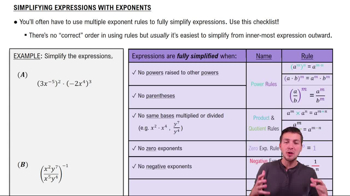
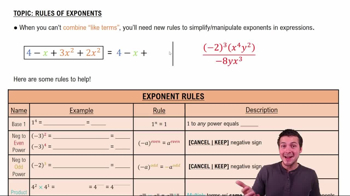
Introduction to Exponent Rules
1279
views
24
rank
1
comments
6:39
Simplifying Exponential Expressions
713
views
29
rank
5:50
Power Rules
753
views
14
rank
Terms in this set (15)
Hide definitions
Exponent
A small raised number indicating how many times a base is multiplied by itself in an expression.
Base
The main number or variable that is repeatedly multiplied according to the value of the exponent.
Product Rule
A shortcut for multiplying like bases by adding their exponents, streamlining lengthy calculations.
Quotient Rule
A method for dividing like bases by subtracting the denominator's exponent from the numerator's exponent.
Power Rule
A rule for simplifying powers raised to powers by multiplying the exponents together.
Power of a Product
A rule where an exponent outside parentheses is distributed to each factor inside the parentheses.
Power of a Quotient
A rule where an exponent outside parentheses is distributed to both the numerator and denominator.
Zero Exponent
A rule stating any nonzero base raised to the zero power equals one, simplifying many expressions.
Negative Exponent
A rule indicating that a negative exponent means taking the reciprocal and using a positive exponent.
Reciprocal
A flipped version of a fraction or term, often used when handling negative exponents.
Like Bases
Bases that are identical, allowing exponent rules such as addition or subtraction to be applied.
Parentheses
Grouping symbols that indicate which terms an exponent applies to, affecting distribution and simplification.
Simplification
The process of using exponent rules to rewrite expressions in their shortest, most efficient form.
Distributive Property
A property allowing an exponent to be applied to each term inside parentheses, similar to multiplication distribution.
Order of Operations
A sequence for evaluating expressions, ensuring exponents are handled before multiplication or division.
 BackBack

 7:39
7:39