Skip to main content
Calculus
My Course
Learn
Exam Prep
AI Tutor
Study Guides
Textbook Solutions
Flashcards
Explore
Try the app
My Course
Learn
Exam Prep
AI Tutor
Study Guides
Textbook Solutions
Flashcards
Explore
Try the app
Back
Introduction to Functions definitions
1 student found this helpful
You can tap to flip the card.
Relation
You can tap to flip the card.
👆
Relation
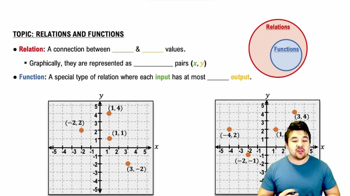
A connection between X and Y values, represented as ordered pairs, where each input can correspond to one or more outputs.
Track progress
Control buttons has been changed to "navigation" mode.
1/15
Related flashcards
Related practice
Recommended videos
Introduction to Functions quiz #1
Introduction to Functions
10 Terms
Introduction to Functions
0. Functions
5 problems
Topic
Patrick
Piecewise Functions
0. Functions
3 problems
Topic
David-Paige
0. Functions - Part 1 of 2
7 topics
14 problems
Chapter
Patrick
0. Functions - Part 2 of 2
8 topics
12 problems
Chapter
David-Paige
Guided course
5:20
Relations and Functions
7951
views
303
rank
3
comments
1:36
Introduction to Calculus Channel
11214
views
280
rank
Guided course
5:10
Finding the Domain and Range of a Graph
4293
views
191
rank
2
comments
Terms in this set (15)
Hide definitions
Relation
A connection between X and Y values, represented as ordered pairs, where each input can correspond to one or more outputs.
Function
A special type of relation where each input is paired with at most one output, ensuring no input has multiple outputs.
Input
An X value in a relation or function, representing the independent variable or starting value in an ordered pair.
Output
A Y value in a relation or function, representing the dependent variable or resulting value in an ordered pair.
Ordered Pair
A notation (x, y) showing the relationship between an input and its corresponding output on a graph.
Vertical Line Test
A graphical method to determine if a graph represents a function by checking if any vertical line crosses more than one point.
Domain
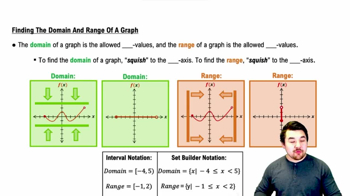
The complete set of allowed X values for a relation or function, often found by projecting the graph onto the X-axis.
Range
The complete set of allowed Y values for a relation or function, often found by projecting the graph onto the Y-axis.
Interval Notation
A concise way to express domain or range using brackets and parentheses to indicate inclusion or exclusion of endpoints.
Set Builder Notation
A notation using inequality symbols to describe domain or range, specifying the conditions that elements must satisfy.
Bracket
A symbol used in interval notation to indicate that an endpoint is included in the domain or range.
Parenthesis
A symbol used in interval notation to indicate that an endpoint is excluded from the domain or range.
Union Symbol
A symbol used to connect multiple intervals in domain or range, indicating the combination of separate sets.
Squish Strategy
A visual technique where a graph is compressed onto an axis to reveal the domain or range.
Open Circle
A graphical marker indicating that a specific value is not included in the domain or range.
 BackBack

 5:20
5:20