Skip to main content
Calculus
My Course
Learn
Exam Prep
AI Tutor
Study Guides
Textbook Solutions
Flashcards
Explore
Try the app
My Course
Learn
Exam Prep
AI Tutor
Study Guides
Textbook Solutions
Flashcards
Explore
Try the app
Back
Introduction to Trigonometric Functions definitions
You can tap to flip the card.
Degree
You can tap to flip the card.
👆
Degree
A unit for measuring angles, where a full circle is divided into 360 equal parts.
Track progress
Control buttons has been changed to "navigation" mode.
1/14
Related flashcards
Related practice
Recommended videos
Introduction to Trigonometric Functions quiz #1
Introduction to Trigonometric Functions
10 Terms
Introduction to Trigonometric Functions
0. Functions
5 problems
Topic
Ally
Graphs of Trigonometric Functions
0. Functions
3 problems
Topic
Jonathan
0. Functions - Part 1 of 2
7 topics
14 problems
Chapter
Patrick
0. Functions - Part 2 of 2
8 topics
12 problems
Chapter
David-Paige
3:03
Trig Values in Quadrants II, III, & IV Example 1
1245
views
22
rank
8:22
Trig Values in Quadrants II, III, & IV Example 2
1141
views
32
rank
Guided course
6:04
Introduction to Trigonometric Functions
1507
views
30
rank
Terms in this set (14)
Hide definitions
Degree
A unit for measuring angles, where a full circle is divided into 360 equal parts.
Radian
A unit for measuring angles based on the arc length equal to the radius of a circle; a full circle is 2π of these.
Circumference
The total distance around a circle, calculated as 2π times the radius.
Reference Angle
An acute angle formed by the terminal side of a given angle and the nearest x-axis.
Quadrant
One of four regions in the coordinate plane, determined by the x and y axes.
Sine
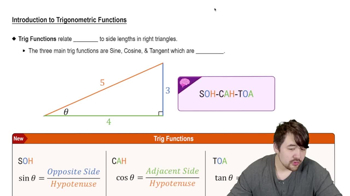
A trigonometric ratio comparing the length of the side opposite an angle to the hypotenuse in a right triangle.
Cosine
A trigonometric ratio comparing the length of the adjacent side to the hypotenuse in a right triangle.
Tangent
A trigonometric ratio comparing the length of the side opposite an angle to the adjacent side in a right triangle.
Hypotenuse
The longest side of a right triangle, always opposite the right angle.
SOHCAHTOA
A mnemonic device summarizing the definitions of sine, cosine, and tangent using side ratios in right triangles.
Conversion Factor
A multiplier, such as π/180 or 180/π, used to switch between degrees and radians.
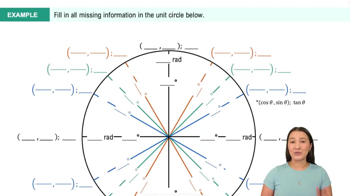
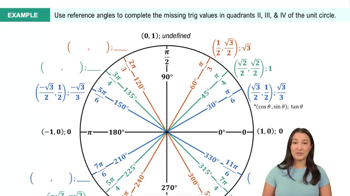
Unit Circle
A circle with radius one, centered at the origin, used to define trigonometric values for all angles.
Sign Convention
A rule indicating which trigonometric functions are positive in each quadrant of the coordinate plane.
All Students Take Calculus
A mnemonic for remembering which trigonometric functions are positive in each quadrant.
 BackBack

 3:03
3:03