Skip to main content
Calculus
My Course
Learn
Exam Prep
AI Tutor
Study Guides
Textbook Solutions
Flashcards
Explore
Try the app
My Course
Learn
Exam Prep
AI Tutor
Study Guides
Textbook Solutions
Flashcards
Explore
Try the app
Back
Logarithmic Functions quiz
1 student found this helpful
You can tap to flip the card.
What is the inverse operation of an exponential function?
You can tap to flip the card.
👆
What is the inverse operation of an exponential function?
The inverse operation of an exponential function is taking the logarithm (log).
Track progress
Control buttons has been changed to "navigation" mode.
1/15
Related flashcards
Related practice
Recommended videos
Logarithmic Functions definitions
Logarithmic Functions
14 Terms
Logarithmic Functions
0. Functions
4 problems
Topic
Ernest
Properties of Logarithms
0. Functions
4 problems
Topic
Ernest
0. Functions - Part 1 of 2
7 topics
14 problems
Chapter
Patrick
0. Functions - Part 2 of 2
8 topics
12 problems
Chapter
David-Paige
7:30
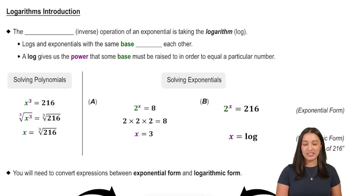
Logarithms Introduction
1402
views
32
rank
2:51
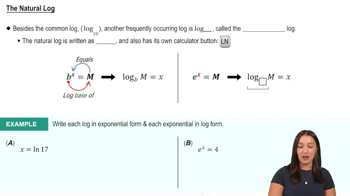
The Natural Log
973
views
20
rank
5:26
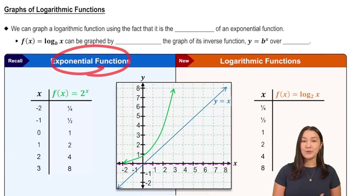
Graphs of Logarithmic Functions
928
views
19
rank
Terms in this set (15)
Hide definitions
What is the inverse operation of an exponential function?
The inverse operation of an exponential function is taking the logarithm (log).
How do you isolate x in the equation 2^x = 216 using logarithms?
Take the log base 2 of both sides to get x = log base 2 of 216.
What does log base 2 of 216 represent?
It represents the power to which 2 must be raised to get 216.
How do you convert the exponential equation 3^x = 81 to logarithmic form?
It becomes log base 3 of 81 equals x, or log₃(81) = x.
How do you convert x = log base 4 of 64 to exponential form?
It becomes 4^x = 64.
What is the common logarithm and how is it written?
The common logarithm is log base 10, and it is written simply as log.
What is the natural logarithm and how is it denoted?
The natural logarithm is log base e and is denoted as ln.
How do you convert x = ln(17) to exponential form?
It becomes e^x = 17.
How do you convert e^x = 4 to logarithmic form?
It becomes ln(4) = x.
What is the relationship between the graphs of exponential and logarithmic functions?
The graph of a logarithmic function is the reflection of its corresponding exponential function across the line y = x.
What is the domain and range of a logarithmic function?
The domain is (0, ∞) and the range is all real numbers (−∞, ∞).
Where is the vertical asymptote of a logarithmic function located?
The vertical asymptote is at x = 0.
How does the base of a logarithmic function affect its graph?
If the base is greater than 1, the graph increases; if the base is between 0 and 1, the graph decreases.
What is always true about log base b of 1 for any base b?
log base b of 1 is always 0, regardless of the base.
How do you remember the notation for the natural logarithm?
Take the first letters of 'natural log', reverse them, and you get 'ln'.
 BackBack

 7:30
7:30