Skip to main content
Calculus
My Course
Learn
Exam Prep
AI Tutor
Study Guides
Textbook Solutions
Flashcards
Explore
Try the app
My Course
Learn
Exam Prep
AI Tutor
Study Guides
Textbook Solutions
Flashcards
Explore
Try the app
Back
Properties of Logarithms definitions
You can tap to flip the card.
Logarithm
You can tap to flip the card.
👆
Logarithm
A mathematical operation that undoes exponentiation, revealing the exponent needed to reach a value from a given base.
Track progress
Control buttons has been changed to "navigation" mode.
1/15
Related flashcards
Related practice
Recommended videos
Properties of Logarithms quiz #1
Properties of Logarithms
10 Terms
Properties of Logarithms
0. Functions
4 problems
Topic
Ernest
Exponential & Logarithmic Equations
0. Functions
3 problems
Topic
Ernest
0. Functions - Part 1 of 2
7 topics
14 problems
Chapter
Patrick
0. Functions - Part 2 of 2
8 topics
12 problems
Chapter
David-Paige
3:49
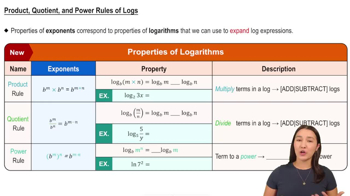
Product, Quotient, and Power Rules of Logs
1051
views
25
rank
5:14
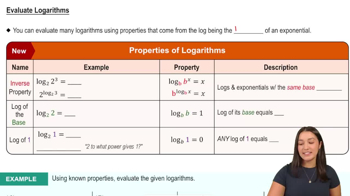
Evaluate Logarithms
1331
views
21
rank
1
comments
4:22
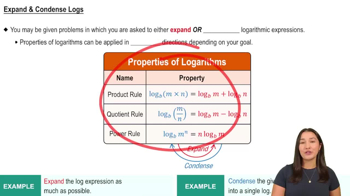
Expand & Condense Log Expressions
974
views
19
rank
1
comments
Terms in this set (15)
Hide definitions
Logarithm
A mathematical operation that undoes exponentiation, revealing the exponent needed to reach a value from a given base.
Exponential Function
A function where a constant base is raised to a variable exponent, forming the inverse relationship with logarithms.
Inverse Property
A rule stating that applying a logarithm and an exponential with the same base cancels both, leaving only the exponent or argument.
Product Rule
A property allowing the logarithm of a product to be written as the sum of the logarithms of the factors.
Quotient Rule
A property allowing the logarithm of a quotient to be written as the difference of the logarithms of the numerator and denominator.
Power Rule
A property allowing an exponent inside a logarithm to be moved in front as a multiplier of the logarithm.
Change of Base Formula
A method for rewriting a logarithm in terms of logs with a different base, using a fraction of two logarithms.
Common Logarithm
A logarithm with base 10, often written simply as 'log' and found as a calculator button.
Natural Logarithm
A logarithm with base e, written as 'ln', commonly used in calculus and available on calculators.
Expansion
The process of rewriting a single logarithmic expression as a sum, difference, or multiple of simpler logs.
Condensation
The process of combining multiple logarithmic terms into a single logarithm using log properties in reverse.
Base
The fixed number in a logarithm or exponential that is raised to a power or used as the reference for the log.
Argument
The value inside a logarithm, representing the number for which the exponent is being solved.
Exponent
The power to which a base is raised in an exponential or the result found by evaluating a logarithm.
Fractional Exponent
An exponent expressed as a fraction, often representing roots, such as 1/3 for a cube root.
 BackBack

 3:49
3:49