Skip to main content
Calculus
My Course
Learn
Exam Prep
AI Tutor
Study Guides
Textbook Solutions
Flashcards
Explore
Try the app
My Course
Learn
Exam Prep
AI Tutor
Study Guides
Textbook Solutions
Flashcards
Explore
Try the app
Back
The Second Derivative Test quiz
You can tap to flip the card.
What does the second derivative test use to identify local extrema?
You can tap to flip the card.
👆
What does the second derivative test use to identify local extrema?
It uses the sign of the second derivative at a critical point to determine if the point is a local maximum or minimum.
Track progress
Control buttons has been changed to "navigation" mode.
1/15
Related flashcards
Related practice
Recommended videos
The Second Derivative Test definitions
The Second Derivative Test
14 Terms
The Second Derivative Test
5. Graphical Applications of Derivatives
3 problems
Topic
Jonathan
Curve Sketching
5. Graphical Applications of Derivatives
3 problems
Topic
Justin
5. Graphical Applications of Derivatives
7 topics
13 problems
Chapter
Ernest
06:02
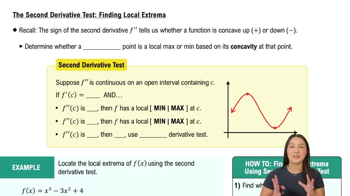
The Second Derivative Test: Finding Local Extrema
1277
views
17
rank
05:34
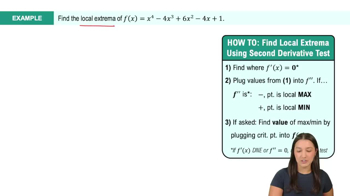
The Second Derivative Test: Finding Local Extrema Example 1
664
views
18
rank
Terms in this set (15)
Hide definitions
What does the second derivative test use to identify local extrema?
It uses the sign of the second derivative at a critical point to determine if the point is a local maximum or minimum.
What does it mean if f'(c) = 0 and f''(c) > 0 at a critical point c?
The function is concave up at c, indicating a local minimum.
What does it mean if f'(c) = 0 and f''(c) < 0 at a critical point c?
The function is concave down at c, indicating a local maximum.
What should you do if f''(c) = 0 at a critical point?
You must use the first derivative test instead, as the second derivative test gives no information.
What is the first step in applying the second derivative test to a function?
Find the first derivative and determine where it equals zero to locate critical points.
When using the second derivative test, do you consider points where the first derivative does not exist?
No, only points where the first derivative equals zero are used; otherwise, revert to the first derivative test.
How do you determine if a critical point is a maximum or minimum using the second derivative?
Plug the critical point into the second derivative and check the sign: negative for maximum, positive for minimum.
In the example f(x) = x^3 - 3x^2 + 4, what are the critical points found using the first derivative?
The critical points are x = 0 and x = 2.
What is the second derivative of f(x) = x^3 - 3x^2 + 4?
The second derivative is f''(x) = 6x - 6.
What does a negative value for the second derivative at a critical point indicate?
It indicates the function is concave down and the critical point is a local maximum.
What does a positive value for the second derivative at a critical point indicate?
It indicates the function is concave up and the critical point is a local minimum.
How do you find the actual value of a local maximum or minimum after finding the critical point?
Plug the critical point back into the original function to get the maximum or minimum value.
Why is the sign of the second derivative more important than its actual value in the second derivative test?
Because the sign tells us about concavity and whether the critical point is a maximum or minimum, not the magnitude.
What is concavity and how is it related to the second derivative?
Concavity describes whether a function curves up or down; positive second derivative means concave up, negative means concave down.
Why is the second derivative test useful in optimization problems?
It quickly identifies local extrema, which are crucial for optimizing functions in calculus and economic models.
 BackBack
 06:02
06:02