Skip to main content
Cell Biology
My Course
Learn
Exam Prep
AI Tutor
Study Guides
Flashcards
Explore
Try the app
My Course
Learn
Exam Prep
AI Tutor
Study Guides
Flashcards
Explore
Try the app
Back
Actin Based Movement definitions
You can tap to flip the card.
Actin
You can tap to flip the card.
👆
Actin
A protein forming dynamic filaments that drive the extension of cellular protrusions during non-muscle movement.
Track progress
Control buttons has been changed to "navigation" mode.
1/15
Related flashcards
Related practice
Recommended videos
Actin Based Movement quiz #1
Actin Based Movement
10 Terms
Actin Based Movement
15. Cytoskeleton and Cell Movement
7 problems
Topic
Muscle Contractions
15. Cytoskeleton and Cell Movement
7 problems
Topic
15. Cytoskeleton and Cell Movement - Part 1 of 2
5 topics
14 problems
Chapter
15. Cytoskeleton and Cell Movement - Part 2 of 2
5 topics
13 problems
Chapter
Guided course
05:04
Cell Crawling
725
views
4
rank
Terms in this set (15)
Hide definitions
Actin
A protein forming dynamic filaments that drive the extension of cellular protrusions during non-muscle movement.
Cell Crawling
A process where an entire cell moves across a surface using actin-based protrusions and surface attachments.
Chemotaxis
A movement response of a cell toward or away from varying chemical concentrations in its environment.
Cytoplasmic Streaming
The rapid flow of cytosol within a cell, creating visible internal movement, especially in plant cells and slime molds.
Protrusion
The initial extension of actin-rich structures from a cell's surface, enabling forward movement.
Attachment
The step where a cell adheres to a surface or extracellular matrix using specialized membrane proteins.
Translocation
The stage where the cell's body is pulled forward, anchored by surface attachments, after protrusion.
Detachment
The release of cell-surface connections, allowing the cell to repeat the movement cycle.
Pseudopodia
Actin-based extensions typical in amoebas, used to reach out and pull the cell forward during movement.
Lamellipodia
Broad, sheet-like actin-rich protrusions at the leading edge of a moving cell.
Filopodia
Thin, spike-like actin-based projections at the cell's leading edge, aiding in sensing and movement.
Integrins
Transmembrane proteins on the cell surface that anchor the cell to the extracellular matrix, acting like Velcro.
Extracellular Matrix
A network outside the cell to which surface proteins attach during cell crawling.
Plasma Membrane
The cell's outer boundary where actin-based protrusions extend and integrins are embedded.
Cytosol
The fluid component inside the cell where cytoplasmic streaming occurs.
 BackBack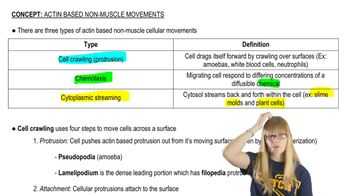
 05:04
05:04