Skip to main content
Cell Biology
My Course
Learn
Exam Prep
AI Tutor
Study Guides
Flashcards
Explore
Try the app
My Course
Learn
Exam Prep
AI Tutor
Study Guides
Flashcards
Explore
Try the app
Back
ATP Synthesis Driven from Proton Gradients definitions
You can tap to flip the card.
Electrochemical Gradient
You can tap to flip the card.
👆
Electrochemical Gradient
Combination of voltage and concentration differences of protons across the inner mitochondrial membrane, driving energy conversion.
Track progress
Control buttons has been changed to "navigation" mode.
1/15
Related flashcards
Related practice
Recommended videos
ATP Synthesis Driven from Proton Gradients quiz #1
ATP Synthesis Driven from Proton Gradients
11 Terms
ATP Synthesis Driven from Proton Gradients
11. Aerobic Respiration
7 problems
Topic
Electron Transport
11. Aerobic Respiration
7 problems
Topic
11. Aerobic Respiration
5 topics
15 problems
Chapter
Guided course
08:51
ATP Synthesis
647
views
4
rank
2
comments
Terms in this set (15)
Hide definitions
Electrochemical Gradient
Combination of voltage and concentration differences of protons across the inner mitochondrial membrane, driving energy conversion.
Electron Transport Chain
Series of protein complexes in the inner mitochondrial membrane that establishes a proton gradient by moving electrons.
Inner Mitochondrial Membrane
Site where the proton gradient forms and ATP synthesis occurs, separating mitochondrial matrix from intermembrane space.
Chemiosmotic Coupling
Process linking the movement of protons down their gradient to the synthesis of ATP via a membrane protein complex.
ATP Synthase
Transmembrane enzyme complex that uses proton flow to catalyze the formation of ATP from ADP and phosphate.
F1F0 ATP Synthase
Dual-component enzyme with a stationary head and a rotational subunit, essential for ATP production in mitochondria.
F0 Subunit
Stationary portion of ATP synthase embedded in the membrane, catalyzing ATP formation and facilitating proton entry.
F1 Subunit
Rotational component of ATP synthase that undergoes conformational changes, enabling ATP synthesis.
Proton Gradient
Difference in proton concentration across the inner mitochondrial membrane, creating potential energy for ATP production.
Conformational Change
Structural shift in ATP synthase triggered by proton movement, essential for the enzyme's catalytic activity.
Open Stage
Initial state of ATP synthase where binding affinity for ATP and ADP is low, preceding substrate binding.
Loose Stage
Intermediate state of ATP synthase where ADP and phosphate are bound but not yet converted to ATP.
Tight Stage
Catalytic state of ATP synthase where ADP and phosphate are tightly bound, resulting in ATP formation.
Proton Pumping
Active movement of protons across the membrane, establishing the gradient necessary for ATP synthesis.
Rotational Catalysis
Mechanism by which the rotation of ATP synthase's subunit drives the sequential synthesis of ATP.
 BackBack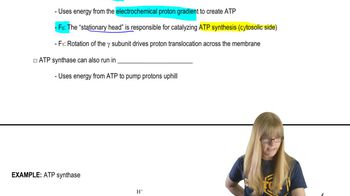
 08:51
08:51