Back

Bioinformatics definitions

Control buttons has been changed to "navigation" mode.
1/13
  • Bioinformatics

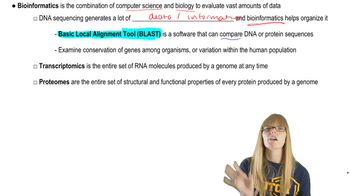
    Integration of computational tools and biology to manage, analyze, and interpret vast biological datasets.
  • DNA Sequence

    Linear arrangement of nucleotides in a DNA molecule, serving as the blueprint for genetic information.
  • Genome

    Complete set of genetic material present in an organism, encompassing all DNA sequences.
  • BLAST

    Software tool that compares input sequences to databases, revealing similarities and gene identities across species.
  • Gene Conservation

    Degree to which a gene's sequence remains unchanged across different organisms, indicating evolutionary importance.
  • Gene Variation

    Differences in genetic sequences among individuals or populations, contributing to diversity and traits.
  • Transcriptomics

    Comprehensive study of all RNA molecules produced by cells, reflecting dynamic gene expression patterns.
  • RNA Molecule

    Single-stranded nucleic acid transcribed from DNA, crucial for protein synthesis and gene regulation.
  • Proteomics

    Large-scale analysis of protein structures, functions, and modifications within a biological system.
  • Protein-Coding Region

    Segment of DNA that contains instructions for synthesizing a specific protein.
  • Protein Modification

    Chemical or structural changes to proteins after synthesis, affecting their function and diversity.
  • Proteome

    Entire collection of proteins expressed by a genome, cell, tissue, or organism at a given time.
  • Data Analysis

    Systematic computational examination of large biological datasets to extract meaningful patterns and insights.