Back

Bioinformatics quiz

Control buttons has been changed to "navigation" mode.
1/15
  • What is bioinformatics?

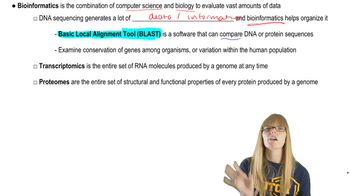
    Bioinformatics is the combination of computer science and biology used to organize and analyze large biological datasets.
  • What type of data does bioinformatics help analyze?

    Bioinformatics helps analyze large datasets such as DNA, RNA, and protein sequences.
  • What does BLAST stand for?

    BLAST stands for Basic Local Alignment Search Tool.
  • What is the main function of BLAST?

    BLAST identifies similar DNA, RNA, or protein sequences across different organisms.
  • How can BLAST help identify a gene?

    By inputting a sequence into BLAST, it can match it to known genes and determine its identity and similarity to other sequences.
  • What is transcriptomics?

    Transcriptomics is the study of the entire set of RNA molecules produced by cells at any given time.
  • Why does the transcriptome of a cell change over time?

    The transcriptome changes because cells constantly produce new RNA molecules as gene expression varies over time.
  • What is proteomics?

    Proteomics is the study of the structural and functional properties of all proteins produced by a genome.
  • Approximately how many protein-coding regions are in the human genome?

    Humans have about 20,000 to 25,000 protein-coding regions.
  • Why is bioinformatics essential for proteomics?

    Bioinformatics is essential for organizing and interpreting the complex data about protein structures, functions, and modifications.
  • What kind of gene variations can bioinformatics help analyze?

    Bioinformatics can analyze gene variations within human populations and across different organisms.
  • How does bioinformatics contribute to understanding protein modifications?

    Bioinformatics helps track and interpret the many possible modifications that proteins can undergo.
  • Why is organizing biological data important in research?

    Organizing biological data is important because it allows scientists to extract meaningful information from vast and complex datasets.
  • What is one challenge of transcriptomics that bioinformatics helps address?

    Bioinformatics helps manage and analyze the massive and constantly changing data generated by transcriptomics.
  • How does bioinformatics impact the study of gene conservation?

    Bioinformatics tools like BLAST allow researchers to compare sequences and study how genes are conserved across different species.