Back

DNA Cloning definitions

Control buttons has been changed to "navigation" mode.
1/12
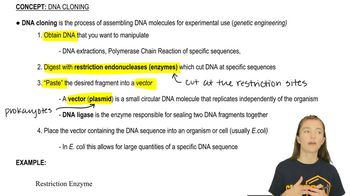
  • DNA Cloning

    Process for generating multiple identical copies of a specific DNA segment for research or therapeutic use.
  • Target DNA

    Specific gene or DNA segment selected for isolation, study, or manipulation during cloning.
  • Polymerase Chain Reaction

    Technique used to amplify a chosen DNA sequence, producing many copies from a small initial sample.
  • Restriction Enzyme

    Protein that recognizes and cuts DNA at specific nucleotide sequences, enabling precise DNA manipulation.
  • Restriction Site

    Short, specific DNA sequence recognized and cleaved by a corresponding restriction enzyme.
  • Vector

    DNA molecule, often a plasmid, used to carry and replicate foreign DNA within a host cell.
  • Plasmid

    Small, circular DNA molecule in prokaryotes that replicates independently from the chromosomal DNA.
  • DNA Ligase

    Enzyme that covalently joins DNA fragments, sealing nicks to create a continuous double-stranded molecule.
  • Recombinant Plasmid

    Engineered plasmid containing both original and inserted foreign DNA, used for propagation in host cells.
  • E. coli

    Bacterial species commonly used as a host for propagating recombinant DNA due to its rapid growth and ease of manipulation.
  • Gene Therapy

    Medical application involving the introduction of cloned genes to treat or prevent genetic disorders.
  • Transgenic Experiment

    Procedure involving the introduction of foreign DNA into an organism to study gene function or create modified traits.