Back

DNA Cloning quiz

Control buttons has been changed to "navigation" mode.
1/15
  • What is the main purpose of DNA cloning in cell biology?

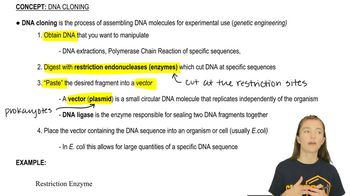
    DNA cloning is used to create copies of small segments of target DNA for study, not to clone entire organisms.
  • What is the first step in DNA cloning?

    The first step is to obtain the desired DNA segment from an organism, often using PCR.
  • What role do restriction enzymes play in DNA cloning?

    Restriction enzymes cut DNA at specific sequences, allowing precise isolation of the target segment.
  • How do restriction enzymes recognize where to cut DNA?

    They recognize unique restriction sites, which are specific DNA sequences, and cut at those locations.
  • What is a vector in the context of DNA cloning?

    A vector, commonly a plasmid, is a DNA molecule used to carry and replicate the target DNA segment in a host organism.
  • Why must the plasmid be cut with the same restriction enzyme as the target DNA?

    Using the same restriction enzyme ensures compatible ends for binding the DNA fragment to the plasmid.
  • What enzyme is used to seal the DNA fragment into the plasmid?

    DNA ligase is used to glue the DNA fragment into the plasmid, creating a recombinant plasmid.
  • What is a recombinant plasmid?

    A recombinant plasmid contains both the original plasmid DNA and the inserted target DNA segment.
  • Which organism is commonly used as a host for DNA cloning?

    E. coli is commonly used as a host organism for DNA cloning.
  • Why are plasmids useful in DNA cloning?

    Plasmids replicate independently of the host chromosome, allowing for many copies of the target DNA.
  • What happens to the recombinant plasmid after it is placed in E. coli?

    The plasmid and E. coli replicate, producing many copies of the plasmid and the target DNA segment.
  • What are some applications of DNA cloning?

    DNA cloning is used for studying genes, transgenic experiments, and gene therapy.
  • How is the target DNA segment obtained from the vector after cloning?

    The vectors are removed from E. coli and the target DNA segment is cut out for further use.
  • What is the significance of restriction sites in DNA cloning?

    Restriction sites are specific sequences where restriction enzymes cut, enabling precise DNA manipulation.
  • Why is DNA cloning important for gene therapy?

    It allows scientists to replicate genes needed for therapy in large quantities for research and treatment.