Back

DNA Transfer into Cells quiz

Control buttons has been changed to "navigation" mode.
1/15
  • What is transfection in the context of DNA transfer into cells?

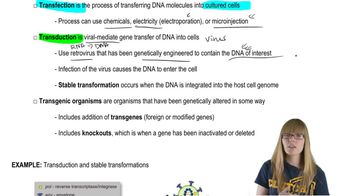
    Transfection is the process of introducing DNA into cultured cells using methods such as chemicals, electroporation, or microinjection.
  • Name two methods used in transfection to introduce DNA into cells.

    Two methods used in transfection are electroporation (using electricity) and microinjection (using a needle to inject DNA).
  • What is transduction and how does it differ from transfection?

    Transduction is the process of introducing DNA into cells using viruses, typically retroviruses, whereas transfection uses non-viral methods.
  • What type of virus is commonly used in transduction and why?

    Retroviruses are commonly used in transduction because they can convert their RNA into DNA and integrate it into the host cell's genome.
  • What is stable transformation in the context of DNA transfer?

    Stable transformation refers to the integration of introduced DNA into the host cell's genome, ensuring it remains in the cell and is passed to progeny during cell division.
  • Why is stable transformation considered a stronger technique than transfection?

    Stable transformation is stronger because the introduced DNA is integrated into the genome and inherited by daughter cells, while transfection DNA is not integrated and is lost over time.
  • What is a transgenic organism?

    A transgenic organism is one whose DNA has been genetically altered by adding foreign genes (transgenes) or by knocking out existing genes.
  • What is a transgene?

    A transgene is a gene from another organism or a modified gene that is introduced into the genome of a transgenic organism.
  • What does a gene knockout involve?

    A gene knockout involves inactivating or deleting a gene, either by introducing a mutation or by removing the gene entirely from the genome.
  • How does a retrovirus introduce DNA into a host cell during transduction?

    A retrovirus carries RNA, which is converted into DNA inside the host cell, and this DNA is then integrated into the host cell's genome.
  • What happens to the introduced DNA during stable transformation when the host cell divides?

    The introduced DNA is copied along with the host genome and passed on to all progeny cells.
  • Why do scientists use viruses engineered with specific DNA in transduction?

    Scientists engineer viruses to carry the DNA of interest so that, upon infection, the desired DNA is delivered and integrated into the target cell's genome.
  • What is the main advantage of using viral-mediated DNA transfer (transduction) over chemical methods?

    Viral-mediated DNA transfer ensures efficient delivery and stable integration of DNA into the host genome, which chemical methods do not guarantee.
  • What is the initial form of genetic material in a retrovirus, and what does it become in the host cell?

    The initial form is RNA, which is converted into DNA inside the host cell.
  • What is the fate of non-integrated DNA introduced by transfection after several cell divisions?

    Non-integrated DNA introduced by transfection is not passed on during cell division and is eventually lost from the cell population.