Skip to main content
Cell Biology
My Course
Learn
Exam Prep
AI Tutor
Study Guides
Flashcards
Explore
Try the app
My Course
Learn
Exam Prep
AI Tutor
Study Guides
Flashcards
Explore
Try the app
Back
DNA vs. RNA definitions
You can tap to flip the card.
Uracil
You can tap to flip the card.
👆
Uracil
A nitrogenous base unique to RNA, replacing thymine and pairing with adenine during transcription.
Track progress
Control buttons has been changed to "navigation" mode.
1/12
Related flashcards
Related practice
Recommended videos
DNA vs. RNA quiz #1
DNA vs. RNA
10 Terms
DNA vs. RNA
4. DNA, Chromosomes, and Genomes
7 problems
Topic
Packaging of DNA
4. DNA, Chromosomes, and Genomes
7 problems
Topic
4. DNA, Chromosomes, and Genomes - Part 1 of 2
5 topics
14 problems
Chapter
4. DNA, Chromosomes, and Genomes - Part 2 of 2
5 topics
13 problems
Chapter
Guided course
01:58
RNA
660
views
7
rank
Terms in this set (12)
Hide definitions
Uracil
A nitrogenous base unique to RNA, replacing thymine and pairing with adenine during transcription.
Thymine
A nitrogenous base found in DNA but absent in RNA, pairing with adenine in the double helix.
Single-stranded polymer
A nucleic acid structure where nucleotides form a single chain, typical of most RNA molecules.
Double-stranded polymer
A nucleic acid structure with two complementary chains, characteristic of DNA's double helix.
Double helix
A stable, twisted ladder-like structure formed by two complementary DNA strands.
Hairpin
A short RNA secondary structure where a sequence folds back and pairs with itself, forming a tight loop.
Stem loop
A larger RNA secondary structure with a paired stem and an unpaired loop, contributing to 3D folding.
Ribozyme
A catalytic RNA molecule capable of accelerating chemical reactions, unlike DNA.
Transfer RNA
A type of RNA with a complex 3D shape, involved in protein synthesis and capable of forming loops.
Catalytic activity
A functional property where certain RNA molecules accelerate biochemical reactions, a role not seen in DNA.
Three-dimensional structure
A complex folding pattern in RNA, enabling unique shapes and functions beyond the double helix.
Nitrogenous base
A molecular component of nucleic acids, including uracil and thymine, that pairs to encode genetic information.
 BackBack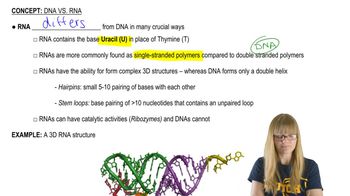
 01:58
01:58