Skip to main content
Cell Biology
My Course
Learn
Exam Prep
AI Tutor
Study Guides
Flashcards
Explore
Try the app
My Course
Learn
Exam Prep
AI Tutor
Study Guides
Flashcards
Explore
Try the app
Back
Enzymes and Protein Binding definitions
You can tap to flip the card.
Binding Site
You can tap to flip the card.
👆
Binding Site
Region on a protein where specific molecules attach, determining the protein's interaction and function.
Track progress
Control buttons has been changed to "navigation" mode.
1/15
Related flashcards
Related practice
Recommended videos
Enzymes and Protein Binding quiz
Enzymes and Protein Binding
15 Terms
Enzymes and Protein Binding
6. Proteins
7 problems
Topic
Protein Regulation
6. Proteins
7 problems
Topic
6. Proteins - Part 1 of 2
3 topics
9 problems
Chapter
6. Proteins - Part 2 of 2
3 topics
9 problems
Chapter
Guided course
06:40
Protein Binding
720
views
7
rank
1
comments
Guided course
02:48
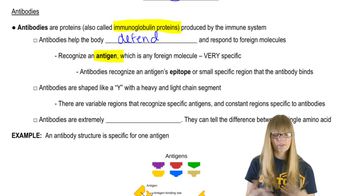
Antibodies
520
views
2
rank
1
comments
Guided course
01:58
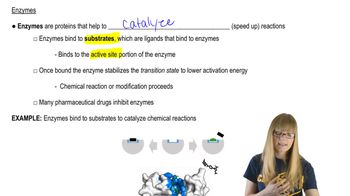
Enzymes
487
views
2
rank
Terms in this set (15)
Hide definitions
Binding Site
Region on a protein where specific molecules attach, determining the protein's interaction and function.
Ligand
Molecule that attaches to a protein's binding site, often triggering or regulating biological activity.
Affinity
Measurement of the strength of interaction between a protein and its ligand, influencing biological outcomes.
Non-covalent Bonds
Weak chemical interactions, such as hydrogen bonds, that stabilize protein-ligand complexes without sharing electrons.
Molecular Complementarity
Compatibility of shape and chemical properties between a protein and ligand, enabling precise binding.
Surface Conformation
Three-dimensional arrangement of a protein's exterior, affecting ligand access and binding dynamics.
Molecular Channel
Internal passage within a protein that isolates ligands from the environment, often preventing unwanted reactions.
Antibody
Y-shaped immune protein that binds foreign molecules with high specificity, aiding in recognition and defense.
Antigen
Foreign molecule recognized by the immune system, often targeted by antibodies for neutralization.
Epitope
Small, specific region on an antigen recognized and bound by an antibody's variable region.
Variable Region
Segment of an antibody responsible for recognizing and binding unique antigenic structures.
Constant Region
Portion of an antibody that remains unchanged across different antibodies, providing structural stability.
Enzyme
Protein catalyst that accelerates chemical reactions by lowering activation energy through substrate binding.
Substrate
Specific molecule upon which an enzyme acts, binding at the active site to undergo a chemical transformation.
Active Site
Specialized region on an enzyme where substrates bind and reactions are facilitated.
 BackBack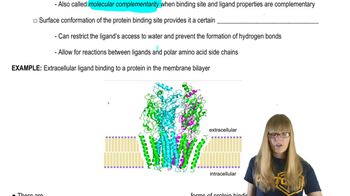
 06:40
06:40