A protein binding site is a specific region on a protein where it binds to other molecules or proteins.
What is a ligand in the context of protein binding?
A ligand is a substance that binds to a protein at its binding site.
How is affinity defined in protein-ligand interactions?
Affinity is a measurement of how strong the interaction is between a protein and its ligand.
What type of bonds primarily hold protein-ligand interactions together?
Protein-ligand interactions are primarily held together by non-covalent bonds.
What does molecular complementarity mean?
Molecular complementarity refers to the matching properties (like shape or charge) between a protein and its ligand that allow them to interact strongly.
How does the surface conformation of a binding site affect ligand interaction?
The surface conformation of a binding site affects the chemistry and environment, influencing how the ligand can interact with the protein.
Name two common forms of protein-protein or protein-molecule binding.
Two common forms are surface-surface binding and molecular channel binding.
What is the function of molecular channels in proteins?
Molecular channels sequester ligands away from the environment, often to prevent unwanted interactions or reactions.
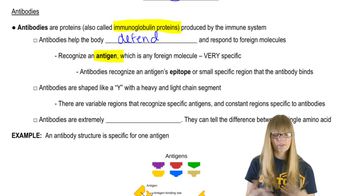
What are antibodies and what do they bind to?
Antibodies are immunoglobulin proteins produced by the immune system that bind to antigens.
What is an epitope?
An epitope is a small, specific region of an antigen that an antibody recognizes and binds to.
What are the variable and constant regions of an antibody?
The variable region recognizes the antigen's epitope, while the constant region remains the same across different antibodies.
How specific are antibodies in recognizing antigens?
Antibodies are extremely specific and can distinguish between antigens that differ by just a single amino acid.
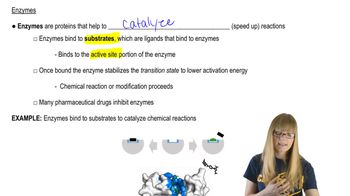
What is an enzyme and what does it bind to?
An enzyme is a protein that catalyzes reactions by binding to a substrate at its active site.
What is the active site of an enzyme?
The active site is the region on an enzyme where the substrate binds and the chemical reaction occurs.
How do pharmaceutical drugs often affect enzymes?
Pharmaceutical drugs often inhibit enzymes, affecting protein binding and altering biochemical pathways.
 Back
Back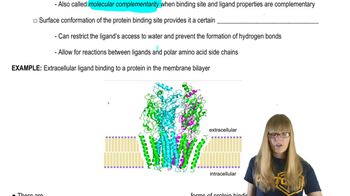
 06:40
06:40