Skip to main content
Cell Biology
My Course
Learn
Exam Prep
AI Tutor
Study Guides
Flashcards
Explore
Try the app
My Course
Learn
Exam Prep
AI Tutor
Study Guides
Flashcards
Explore
Try the app
Back
Fermentation definitions
You can tap to flip the card.
Anaerobic Respiration
You can tap to flip the card.
👆
Anaerobic Respiration
Cellular process generating ATP without oxygen, involving glycolysis and fermentation, and yielding less energy than aerobic pathways.
Track progress
Control buttons has been changed to "navigation" mode.
1/15
Related flashcards
Related practice
Recommended videos
Fermentation quiz
Fermentation
15 Terms
Fermentation
10. Anaerobic Respiration
7 problems
Topic
Gluconeogenesis
10. Anaerobic Respiration
7 problems
Topic
10. Anerobic Respiration
4 topics
12 problems
Chapter
Guided course
09:58
Fermentation
748
views
10
rank
1
comments
Terms in this set (15)
Hide definitions
Anaerobic Respiration
Cellular process generating ATP without oxygen, involving glycolysis and fermentation, and yielding less energy than aerobic pathways.
Glycolysis
Initial metabolic pathway breaking down glucose into pyruvate, producing ATP and NADH, and functioning without oxygen.
Fermentation
Metabolic process regenerating NAD+ from NADH, enabling glycolysis to persist in the absence of oxygen.
NAD+
Electron carrier molecule required for glycolysis, regenerated during fermentation to sustain ATP production.
NADH
Reduced electron carrier formed during glycolysis, donates electrons during fermentation to regenerate NAD+.
Pyruvate
Three-carbon molecule produced from glucose during glycolysis, serving as an electron acceptor in fermentation.
Alcohol Fermentation
Pathway converting pyruvate into ethanol and CO2, used by yeast, and regenerating NAD+ for glycolysis.
Lactic Acid Fermentation
Pathway converting pyruvate into lactate, used by muscle cells under low oxygen, and regenerating NAD+.
Ethanol
Alcoholic byproduct of fermentation in yeast, not further used for energy, and important in brewing and baking.
Lactic Acid
Byproduct of fermentation in muscle cells, associated with muscle soreness and not further metabolized for energy.
Electron Carrier
Molecule that temporarily holds electrons during metabolic reactions, crucial for transferring energy in cells.
ATP
Primary energy currency of the cell, produced in small amounts during anaerobic respiration compared to aerobic pathways.
Yeast
Microorganisms utilizing alcohol fermentation to produce ethanol and CO2, essential in baking and brewing industries.
Byproduct
Substance formed during fermentation, such as ethanol or lactic acid, not further used for cellular energy.
Electron Acceptor
Molecule, such as pyruvate, that receives electrons during fermentation, enabling regeneration of NAD+.
 BackBack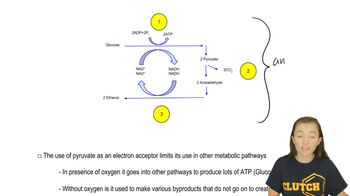
 09:58
09:58