Skip to main content
Cell Biology
My Course
Learn
Exam Prep
AI Tutor
Study Guides
Flashcards
Explore
Try the app
My Course
Learn
Exam Prep
AI Tutor
Study Guides
Flashcards
Explore
Try the app
Back
Four Classes of Macromolecules definitions
You can tap to flip the card.
Polysaccharide
You can tap to flip the card.
👆
Polysaccharide
Large carbohydrate formed by repeated monosaccharide units linked by glycosidic bonds, serving as energy storage or structural support.
Track progress
Control buttons has been changed to "navigation" mode.
1/15
Related flashcards
Related practice
Recommended videos
Four Classes of Macromolecules quiz #1
Four Classes of Macromolecules
10 Terms
Four Classes of Macromolecules
2. Chemical Components of Cells
7 problems
Topic
Properties of Macromolecules
2. Chemical Components of Cells
7 problems
Topic
2. Chemical Components of Cells
5 topics
14 problems
Chapter
Guided course
04:36
Polysaccharides
1138
views
13
rank
2
comments
Guided course
03:35
Proteins
770
views
7
rank
Guided course
04:06
Lipids
709
views
4
rank
1
comments
Terms in this set (15)
Hide definitions
Polysaccharide
Large carbohydrate formed by repeated monosaccharide units linked by glycosidic bonds, serving as energy storage or structural support.
Monosaccharide
Simple sugar subunit with a basic chemical formula, acting as the building block for larger carbohydrate molecules.
Glycosidic Bond
Covalent linkage between monosaccharides, formed via carbon and hydroxyl groups, connecting sugar units in carbohydrates.
Nucleotide
Subunit of nucleic acids, consisting of a base, a five-carbon sugar, and a phosphate group, essential for genetic information.
Phosphodiester Bond
Covalent connection joining nucleotides in nucleic acids, crucial for the linear sequence encoding genetic instructions.
Purine
Nitrogenous base with two fused rings, found in DNA and RNA, including adenine and guanine.
Pyrimidine
Single-ring nitrogenous base present in nucleic acids, such as cytosine, thymine, and uracil.
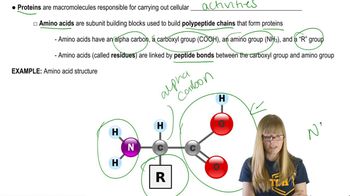
Amino Acid
Organic molecule with an alpha carbon, amino group, carboxyl group, and unique side chain, forming protein subunits.
Peptide Bond
Covalent linkage between the carboxyl group of one amino acid and the amino group of another, forming polypeptide chains.
R Group
Variable side chain of an amino acid, determining its chemical properties and influencing protein structure and function.
Disulfide Bridge
Strong covalent bond between sulfur atoms of cysteine residues, stabilizing protein tertiary structure.
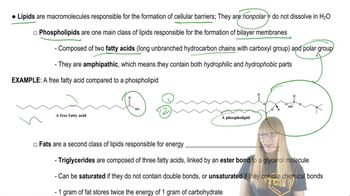
Phospholipid
Amphipathic molecule with two fatty acids and a polar group, forming the structural basis of cellular membranes.
Triglyceride
Lipid composed of three fatty acids linked to glycerol, serving as a dense energy storage molecule.
Steroid
Lipid with a characteristic ring structure, involved in hormone signaling and membrane architecture.
Fatty Acid
Long, unbranched hydrocarbon chain with a terminal carboxyl group, forming part of many lipid molecules.
 BackBack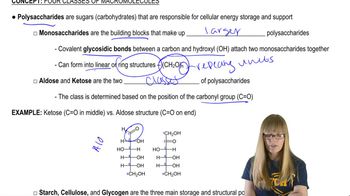
 04:36
04:36