Back

Genetic Screens definitions

Control buttons has been changed to "navigation" mode.
1/15
  • Genetic Screen

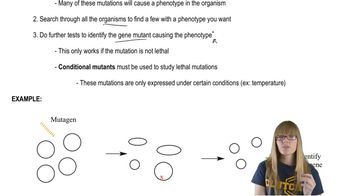
    Technique exposing organisms to mutagens to generate random mutations, enabling identification of genes linked to specific phenotypes.
  • Mutagen

    Agent that induces random changes in DNA, resulting in diverse phenotypes for genetic analysis.
  • Mutation

    Alteration in DNA sequence that can lead to observable changes in organism traits.
  • Phenotype

    Observable characteristic or trait resulting from genetic and environmental influences.
  • Conditional Mutant

    Organism with a mutation expressed only under specific conditions, allowing study of otherwise lethal gene changes.
  • Temperature Sensitive Mutant

    Variant expressing a mutant phenotype only at certain temperatures, useful for studying essential genes.
  • Complementation Test

    Genetic analysis determining if mutations with similar phenotypes affect the same or different genes.
  • Epistasis Analysis

    Method to establish the functional order of genes in a pathway by analyzing mutant phenotypes.
  • Genome

    Complete set of genetic material in an organism, targeted in large-scale mutation studies.
  • Homozygous Recessive

    Genotype with two identical recessive alleles, often used in genetic crosses for analysis.
  • Wild Type

    Reference phenotype or genotype considered standard or typical in a population.
  • Signaling Pathway

    Series of molecular interactions transmitting signals, often dissected using genetic screens and epistasis analysis.
  • Essential Gene

    Gene required for organism survival; mutations typically lethal unless studied with conditional mutants.
  • Cell Growth

    Process of cellular increase in size or number, frequently used as a phenotype in genetic screens.
  • Mutant Phenotype

    Trait differing from the wild type, resulting from a genetic alteration and selected during screens.