Back

Genetic Screens quiz

Control buttons has been changed to "navigation" mode.
1/15
  • What is the main purpose of a genetic screen?

    A genetic screen is used to evaluate the function of thousands of genes at once, especially when gene functions are unknown.
  • How are mutations introduced in a genetic screen?

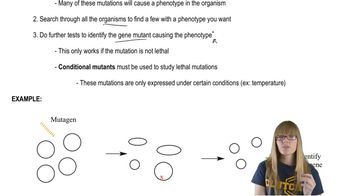
    Mutations are introduced by exposing organisms to mutagens, which cause random mutations across the genome.
  • Why are genetic screens particularly useful when gene functions are unknown?

    They allow researchers to test many genes simultaneously without prior knowledge of their functions or locations in the genome.
  • What is a mutagen and what does it do in genetic screens?

    A mutagen is an agent that causes mutations, leading to various phenotypes in the organisms exposed to it.
  • After mutagenesis, how do researchers select organisms for further study?

    Researchers select organisms that display the specific phenotype of interest, such as changes in cell growth or size.
  • Why are genetic screens generally only useful for non-lethal mutations?

    Because further tests require living organisms, and lethal mutations would kill the organism before more analysis can be done.
  • What is a conditional mutant and when is it used?

    A conditional mutant expresses its mutation only under specific conditions, allowing study of essential genes that would otherwise be lethal if mutated.
  • Give an example of a condition that can be used to express a conditional mutant.

    Temperature is a common condition; for example, a temperature-sensitive mutant expresses the mutant phenotype only at a certain temperature.
  • What is the purpose of a complementation test in genetic analysis?

    A complementation test determines whether mutations in different organisms affect the same gene.
  • How do you interpret the results of a complementation test if the mutant phenotype is still seen in the offspring?

    If the mutant phenotype persists, the mutations are in the same gene.
  • What does it mean if a complementation test results in a wild-type phenotype?

    It means the mutations are in different genes.
  • What is the purpose of epistasis analysis in genetic screens?

    Epistasis analysis helps determine the order of gene function in a pathway.
  • How can epistasis analysis distinguish the order of genes in a pathway?

    By observing which mutations block the pathway at different steps, researchers can infer which gene acts before another.
  • Why must genetic screens be combined with follow-up tests like complementation and epistasis analysis?

    Because genetic screens identify mutants with interesting phenotypes, but follow-up tests are needed to pinpoint the specific genes and their functions.
  • What is the overall importance of genetic screens and their associated tests in biology?

    They are crucial for identifying gene functions and understanding genetic pathways in organisms.