Skip to main content
Cell Biology
My Course
Learn
Exam Prep
AI Tutor
Study Guides
Flashcards
Explore
Try the app
My Course
Learn
Exam Prep
AI Tutor
Study Guides
Flashcards
Explore
Try the app
Back
Ion Channels and Membrane Potential definitions
You can tap to flip the card.
Ion Channel
You can tap to flip the card.
👆
Ion Channel
A transmembrane protein forming a pore that enables passive movement of small polar molecules, often specific to a single ion.
Track progress
Control buttons has been changed to "navigation" mode.
1/15
Related flashcards
Related practice
Recommended videos
Ion Channels and Membrane Potential quiz #1
Ion Channels and Membrane Potential
11 Terms
Ion Channels and Membrane Potential
9. Transport Across Membranes
7 problems
Topic
Ion Channels and Neurons
9. Transport Across Membranes
7 problems
Topic
9. Transport Across Membranes
5 topics
15 problems
Chapter
Guided course
03:07
Ion Channels
811
views
9
rank
Guided course
05:50
Membrane Potential
757
views
6
rank
2
comments
Terms in this set (15)
Hide definitions
Ion Channel
A transmembrane protein forming a pore that enables passive movement of small polar molecules, often specific to a single ion.
Passive Transport
Movement of molecules across a membrane without energy input, driven by concentration or charge differences.
Gated Channel
A protein pore that opens or closes in response to specific stimuli, regulating ion flow across membranes.
Voltage-Gated Channel
A membrane protein that opens or closes depending on the electrical charge difference across the membrane.
Ligand-Gated Channel
A membrane pore that opens when a specific molecule binds, allowing selective ion passage.
Mechanically-Gated Channel
A protein pore that responds to physical forces, such as vibrations, to regulate ion movement.
Selectivity Filter
A structural feature within a channel that ensures only certain ions, after shedding water, can pass through.
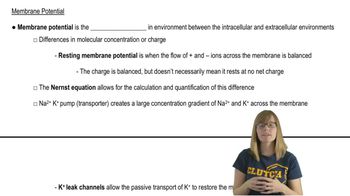
Membrane Potential
The difference in ion concentration and charge between the inside and outside of a cell membrane.
Resting Membrane Potential
A state where the movement of positive and negative ions across the membrane is balanced, not necessarily equal in charge.
Nernst Equation
A mathematical formula used to calculate the concentration and charge differences across a cell membrane.
Sodium-Potassium Pump
A transporter that creates concentration gradients by moving sodium and potassium ions in opposite directions across the membrane.
Potassium Leak Channel
A membrane protein that remains open, allowing potassium ions to flow and help restore membrane potential.
Concentration Gradient
A difference in the amount of a substance on either side of a membrane, driving passive movement.
Patch Clamp Technique
A method using a micropipette to isolate and measure the activity of a single ion channel in a cell membrane.
Micropipette
A tiny glass or similar tube used to isolate a small membrane area for precise measurement of ion channel activity.
 BackBack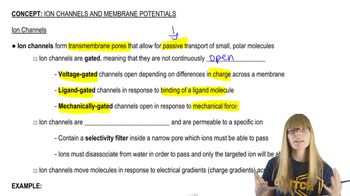
 03:07
03:07