Back

Nucleic Acid Hybridization definitions

Control buttons has been changed to "navigation" mode.
1/14
  • Nucleic Acid Hybridization

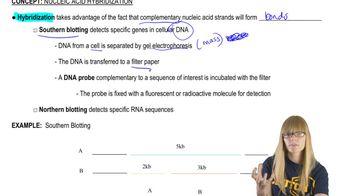
    Process where complementary nucleic acid strands form bonds, enabling detection of specific sequences.
  • Complementary Nucleic Acids

    Nucleotide pairs such as A-T and C-G that specifically bond due to base pairing rules.
  • Southern Blotting

    Technique for detecting specific DNA sequences by transferring DNA to paper and using a labeled probe.
  • Northern Blotting

    Method similar to Southern blotting but used to detect RNA sequences instead of DNA.
  • DNA Probe

    Labeled single-stranded DNA fragment designed to bind a specific complementary sequence on a blot.
  • Gel Electrophoresis

    Laboratory method that separates DNA fragments by size using an electric field in a gel matrix.
  • Fluorescence

    Emission of light from a labeled probe indicating the presence of a target nucleic acid sequence.
  • Radioactive Label

    Tag attached to a probe that emits radiation, allowing detection of hybridized sequences.
  • Base Pair

    Unit formed by hydrogen bonding between two complementary nucleotides in DNA or RNA.
  • Kilobase

    Measurement unit representing one thousand base pairs of nucleic acid sequence.
  • Target Sequence

    Specific region of DNA or RNA that a probe is designed to detect during hybridization.
  • Mass-to-Charge Ratio

    Property used in gel electrophoresis to separate DNA fragments, though for DNA, separation is mainly by size.
  • Incubation

    Step where the blot is exposed to a probe solution to allow hybridization with complementary sequences.
  • Paper Transfer

    Process of moving separated nucleic acids from a gel onto a membrane for probing.