Back

Nucleic Acid Hybridization quiz

Control buttons has been changed to "navigation" mode.
1/15
  • What is nucleic acid hybridization?

    It is the process where complementary nucleic acids form bonds, such as A-T and C-G pairing.
  • What is the main purpose of Southern blotting?

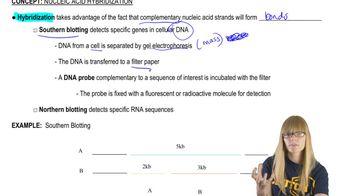
    Southern blotting is used to detect specific genes in cellular DNA.
  • How is DNA separated in Southern blotting?

    DNA is separated by gel electrophoresis, which sorts DNA fragments by size.
  • What is the role of the DNA probe in Southern blotting?

    The DNA probe is complementary to the target sequence and binds if the sequence is present.
  • How is the presence of a target DNA sequence detected in Southern blotting?

    If the probe binds, fluorescence or radioactivity indicates the target sequence is present.
  • What happens if the DNA probe does not bind during Southern blotting?

    No fluorescence or radioactivity is detected, indicating the target sequence is absent.
  • What is the difference between Southern and Northern blotting?

    Southern blotting uses DNA, while Northern blotting uses RNA.
  • What is the first step in Southern blotting?

    The first step is isolating DNA from the organism.
  • What is the purpose of transferring DNA to paper in Southern blotting?

    Transferring DNA to paper allows for incubation with the probe and detection of specific sequences.
  • How is the DNA probe labeled for detection?

    The probe is labeled with a fluorescent or radioactive material.
  • What does gel electrophoresis separate DNA fragments based on?

    Gel electrophoresis separates DNA fragments based on their size.
  • What is an example of DNA fragment sizes detected by Southern blotting?

    Southern blotting can detect DNA fragments of sizes like 5 kb, 2 kb, and 23 kb.
  • What sequence would a probe bind to if the target sequence is ATCGGA?

    The probe would bind to the complementary sequence TAGCCT.
  • What is the main similarity between Southern and Northern blotting?

    Both techniques use a probe to detect the presence of a specific nucleic acid sequence.
  • Why is hybridization important in blotting techniques?

    Hybridization allows the probe to specifically bind to its complementary sequence, enabling detection.