Pearson+ LogoPearson+ Logo
Back

Principles of Transmembrane Transport quiz #1

Control buttons has been changed to "navigation" mode.
1/40
  • What are the main differences between passive and active transport across cell membranes?

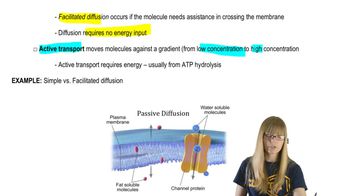
    Passive transport moves molecules from high to low concentration without energy input, either by simple diffusion or facilitated diffusion using membrane proteins. Active transport moves molecules against their concentration gradient (from low to high concentration) and requires energy, usually from ATP.
  • How does the semipermeable nature of the cell membrane affect the movement of different types of molecules?

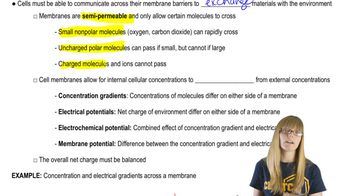
    The semipermeable membrane allows small nonpolar molecules and some small uncharged polar molecules to pass freely, while large polar molecules and charged ions are generally excluded, enabling the cell to regulate its internal environment.
  • What is the difference between concentration gradient, electrical potential, electrochemical potential, and membrane potential?

    A concentration gradient is the difference in molecule concentration across the membrane. Electrical potential is the difference in charge across the membrane. Electrochemical potential combines both concentration and electrical differences as a driving force, while membrane potential refers to the net difference between concentration gradient and electrical potential.
  • What are the three main classes of transmembrane proteins involved in transport, and how do they function?

    Channels allow specific molecules based on size or charge to pass through. Transporters are highly selective, allowing only specific molecules that bind to them to cross. ATP-powered pumps use energy from ATP to move molecules across the membrane, often against their gradient.
  • What property of the cell membrane allows it to regulate which molecules enter or exit the cell?

    The cell membrane is semipermeable, allowing only certain molecules to cross and thus regulating the cell's internal environment.
  • Which types of molecules can freely cross the semipermeable cell membrane, and which are generally excluded?

    Small nonpolar molecules and some small uncharged polar molecules can cross freely, while large polar molecules and charged ions are generally excluded.
  • What is the main difference between passive and active transport across cell membranes?

    Passive transport moves molecules from high to low concentration without energy input, while active transport moves molecules against their gradient and requires energy, usually from ATP.
  • How do simple diffusion and facilitated diffusion differ in passive transport?

    Simple diffusion allows molecules to cross the membrane without assistance, while facilitated diffusion requires the help of membrane proteins but still does not use energy.
  • What are the three main classes of transmembrane proteins involved in transport, and how does each function?

    Channels allow specific molecules based on size or charge to pass, transporters are highly selective for specific molecules, and ATP-powered pumps use ATP to move molecules across the membrane.
  • How do concentration gradient, electrical potential, electrochemical potential, and membrane potential differ?

    Concentration gradient is the difference in molecule concentration, electrical potential is the charge difference, electrochemical potential combines both as a driving force, and membrane potential is the net difference between concentration and electrical potential.
  • What is the difference between diffusion and facilitated diffusion?

    Diffusion is the movement of molecules from high to low concentration without assistance, while facilitated diffusion requires membrane proteins to help molecules cross the membrane, but both do not require energy.
  • How is facilitated diffusion different from simple diffusion?

    Facilitated diffusion uses membrane proteins to help molecules cross the membrane, whereas simple diffusion does not require any assistance.
  • What molecule is necessary for active transport?

    ATP is necessary for active transport.
  • What is the difference between active and passive transport?

    Active transport requires energy to move molecules against their concentration gradient, while passive transport does not require energy and moves molecules down their gradient.
  • How is active transport different from simple diffusion?

    Active transport moves molecules against their concentration gradient using energy, while simple diffusion moves molecules down their gradient without energy input.
  • What is an example of active transport in cells?

    An example of active transport is the use of ATP-powered pumps to move ions across the membrane.
  • Describe the difference between active and passive transport.

    Active transport requires energy to move substances against their gradient, while passive transport moves substances down their gradient without energy.
  • What are the two types of active transport?

    The two types of active transport are primary active transport (using ATP directly) and secondary active transport (using energy from an existing gradient).
  • How does active transport differ from passive transport?

    Active transport requires energy and moves molecules against their gradient; passive transport does not require energy and moves molecules down their gradient.
  • What is the main difference between active and passive transport?

    The main difference is that active transport requires energy input, while passive transport does not.
  • What molecule is used as energy for active transport?

    ATP is used as energy for active transport.
  • Give an example of active transport.

    An example of active transport is the ATP-powered pump moving ions across the cell membrane.
  • How is facilitated diffusion different from active transport?

    Facilitated diffusion does not require energy and moves molecules down their gradient, while active transport requires energy and moves molecules against their gradient.
  • What is the difference between passive transport and active transport?

    Passive transport moves molecules down their gradient without energy; active transport moves molecules against their gradient using energy.
  • What molecule is necessary for active transport?

    ATP is necessary for active transport.
  • What is the difference between simple diffusion and facilitated diffusion?

    Simple diffusion occurs without assistance, while facilitated diffusion requires membrane proteins to help molecules cross.
  • Describe the difference between passive and active transport.

    Passive transport moves substances down their gradient without energy; active transport moves substances against their gradient using energy.
  • What is the best definition of active transport?

    Active transport is the movement of molecules across a membrane against their concentration gradient using energy, usually from ATP.
  • What does it mean that the cell membrane is selectively permeable?

    It means the cell membrane allows only certain molecules to pass through while excluding others, based on size, charge, and polarity.
  • How does passive transport differ from active transport?

    Passive transport does not require energy and moves molecules down their gradient; active transport requires energy and moves molecules against their gradient.
  • How are facilitated diffusion and active transport similar?

    Both facilitated diffusion and active transport use membrane proteins to move molecules across the membrane.
  • How is active transport different from facilitated diffusion?

    Active transport requires energy and moves molecules against their gradient, while facilitated diffusion does not require energy and moves molecules down their gradient.
  • What is the difference between active transport and passive transport?

    Active transport requires energy to move molecules against their gradient; passive transport does not require energy and moves molecules down their gradient.
  • How are facilitated diffusion and active transport different?

    Facilitated diffusion moves molecules down their gradient without energy; active transport moves molecules against their gradient using energy.
  • What type of cell transport requires energy?

    Active transport requires energy.
  • Differentiate between passive and active transport.

    Passive transport moves molecules down their gradient without energy; active transport moves molecules against their gradient using energy.
  • Why does active transport require energy?

    Active transport requires energy because it moves molecules against their concentration gradient.
  • Differentiate between passive and active transport.

    Passive transport does not require energy and moves molecules down their gradient; active transport requires energy and moves molecules against their gradient.
  • Why does active transport require energy?

    Active transport requires energy to move molecules from low to high concentration, against their gradient.
  • What is the best definition of active transport?

    Active transport is the movement of molecules across a membrane against their concentration gradient using energy, typically from ATP.