Skip to main content
Cell Biology
My Course
Learn
Exam Prep
AI Tutor
Study Guides
Flashcards
Explore
Try the app
My Course
Learn
Exam Prep
AI Tutor
Study Guides
Flashcards
Explore
Try the app
Back
Prokaryotic Cell Architecture definitions
You can tap to flip the card.
Prokaryote
You can tap to flip the card.
👆
Prokaryote
Single-celled organism lacking a nucleus, found in Archaea and Bacteria, with diverse shapes, sizes, and metabolic abilities.
Track progress
Control buttons has been changed to "navigation" mode.
1/15
Related flashcards
Related practice
Recommended videos
Prokaryotic Cell Architecture quiz #1
Prokaryotic Cell Architecture
40 Terms
Prokaryotic Cell Architecture quiz #2
Prokaryotic Cell Architecture
15 Terms
Prokaryotic Cell Architecture
1. Overview of Cell Biology
7 problems
Topic
Eukaryotic Cell Architecture
1. Overview of Cell Biology
7 problems
Topic
1. Overview of Cell Biology - Part 1 of 2
5 topics
14 problems
Chapter
1. Overview of Cell Biology - Part 2 of 2
5 topics
13 problems
Chapter
Guided course
02:23
Prokaryotic Features
663
views
7
rank
Guided course
03:41
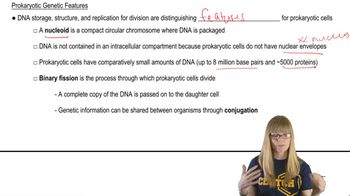
Prokaryotic Genetics
590
views
8
rank
Guided course
04:20
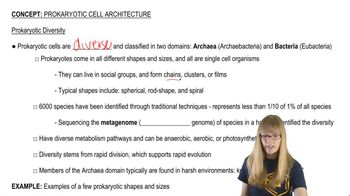
Prokaryotic Diversity
818
views
10
rank
Terms in this set (15)
Hide definitions
Prokaryote
Single-celled organism lacking a nucleus, found in Archaea and Bacteria, with diverse shapes, sizes, and metabolic abilities.
Archaea
Domain of prokaryotes often thriving in extreme environments, distinct from bacteria in genetics and cell structure.
Bacteria
Domain of prokaryotes with vast diversity, commonly found in various habitats, and includes many familiar species.
Biofilm
Community of prokaryotic cells adhering to surfaces and each other, often forming protective layers like dental plaque.
Metagenome
Total genetic material recovered from an environmental sample, revealing the diversity of uncultured prokaryotic species.
Plasma Membrane
Selective barrier surrounding the cell, controlling the movement of substances in and out of prokaryotic cells.
Cell Wall
Rigid outer layer providing structural support and shape to most prokaryotic cells, located outside the plasma membrane.
Cytoskeleton
Network of primitive protein filaments in prokaryotes, maintaining cell shape and aiding in cellular processes.
Flagellum
Long, whip-like appendage enabling motility in many prokaryotic cells, allowing movement toward or away from stimuli.
Nucleoid
Region within a prokaryotic cell where the circular chromosome is located, not enclosed by a membrane.
Circular Chromosome
Closed-loop DNA molecule containing most genetic information in prokaryotes, housed in the nucleoid.
Binary Fission
Asexual cell division process in prokaryotes, producing two genetically identical daughter cells from one parent.
Conjugation
Mechanism of horizontal gene transfer in prokaryotes, involving direct DNA exchange between cells.
Ribosome
Small, less complex molecular machine in prokaryotes, responsible for translating RNA into proteins.
Cyanobacteria
Photosynthetic prokaryotes with complex internal membranes, unique among prokaryotes for this feature.
 BackBack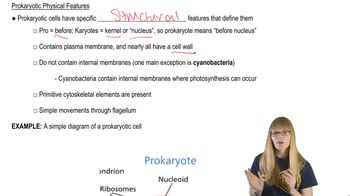
 02:23
02:23