Skip to main content
Cell Biology
My Course
Learn
Exam Prep
AI Tutor
Study Guides
Flashcards
Explore
Try the app
My Course
Learn
Exam Prep
AI Tutor
Study Guides
Flashcards
Explore
Try the app
Back
Protein Folding definitions
You can tap to flip the card.
Primary Structure
You can tap to flip the card.
👆
Primary Structure
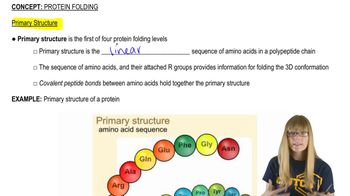
Linear sequence of amino acids in a polypeptide chain, determining folding information through unique R groups.
Track progress
Control buttons has been changed to "navigation" mode.
1/15
Related flashcards
Related practice
Recommended videos
Protein Folding quiz
Protein Folding
15 Terms
Protein Folding
6. Proteins
7 problems
Topic
Complex Protein Structures
6. Proteins
7 problems
Topic
6. Proteins - Part 1 of 2
3 topics
9 problems
Chapter
6. Proteins - Part 2 of 2
3 topics
9 problems
Chapter
Guided course
03:45
Tertiary Structure
842
views
7
rank
Guided course
01:18
Primary Structure
922
views
11
rank
Guided course
01:59
Unstructured Regions
666
views
5
rank
1
comments
Terms in this set (15)
Hide definitions
Primary Structure
Linear sequence of amino acids in a polypeptide chain, determining folding information through unique R groups.
Peptide Bond
Covalent linkage connecting amino acids in a polypeptide, forming the backbone of protein structure.
Secondary Structure
Local folding patterns of the polypeptide backbone, mainly alpha helices and beta sheets stabilized by hydrogen bonds.
Alpha Helix
Rigid, cylindrical structure formed by hydrogen bonds between every fourth amino acid, common in skin proteins.
Beta Sheet
Sheet-like arrangement of polypeptide segments, stabilized by hydrogen bonds, can be parallel or antiparallel.
Tertiary Structure
Three-dimensional conformation of a single polypeptide, integrating motifs and domains for function and stability.
Structural Motif
Combination of secondary structures forming a stable 3D unit, often with a specific function within a protein.
Coiled Coil
Motif where two or three alpha helices wrap around each other, creating a stable, functional structure.
Protein Domain
Independent, stable segment of a polypeptide, often recurring in different proteins and responsible for specific functions.
Domain Shuffling
Evolutionary process mixing domains among proteins, generating new combinations and functional diversity.
Quaternary Structure
Assembly of multiple polypeptide subunits, forming a functional protein complex with non-covalent or disulfide bonds.
Subunit
Individual polypeptide chain within a multimeric protein, which may be identical or different from others.
Homodimer
Protein complex composed of two identical polypeptide subunits.
Heterodimer
Protein complex composed of two non-identical polypeptide subunits.
Unstructured Region
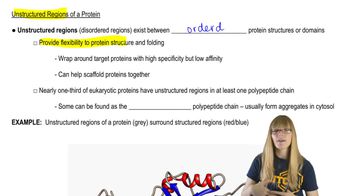
Flexible, disordered segment of a protein, often providing adaptability and unique functional roles.
 BackBack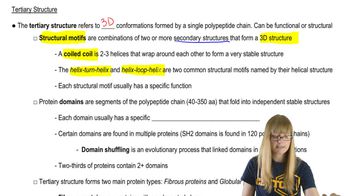
 03:45
03:45