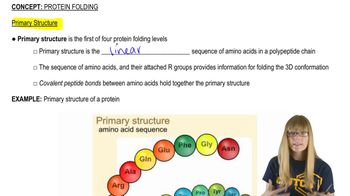
The primary structure is the linear sequence of amino acids in a polypeptide chain, held together by covalent peptide bonds.
What type of bond holds amino acids together in the primary structure?
Covalent peptide bonds hold the amino acids together in the primary structure.
What determines the unique properties of a protein in its primary structure?
The R groups of the amino acids determine the unique properties of the protein.
What are the two main types of secondary structure in proteins?
The two main types are alpha helices and beta sheets.
How are alpha helices formed in protein secondary structure?
Alpha helices are formed by hydrogen bonds between every 4th amino acid, creating a rigid cylindrical structure.
How are beta sheets formed in protein secondary structure?
Beta sheets are formed by hydrogen bonds between segments of the polypeptide chain arranged side by side, which can be parallel or antiparallel.
What is the tertiary structure of a protein?
Tertiary structure is the 3D conformation formed by a single polypeptide chain, involving structural motifs and protein domains.
What is a structural motif in protein tertiary structure?
A structural motif is a combination of two or more secondary structures that form a specific 3D structure, such as a coiled coil.
What is a protein domain?
A protein domain is a larger segment of the polypeptide chain (40–350 amino acids) that folds into an independent, stable structure with a specific function.
What is domain shuffling and why is it important?
Domain shuffling is the evolutionary process of combining different protein domains in new proteins, increasing protein diversity.
What are the two main types of proteins formed by tertiary structure?
The two main types are fibrous proteins (elongated shape) and globular proteins (compact shape).
What is quaternary structure in proteins?
Quaternary structure refers to a protein complex with more than one polypeptide chain (subunits), which can be identical or non-identical.
How are subunits linked in quaternary structure?
Subunits are linked by non-covalent bonds and sometimes by disulfide bonds between cysteines.
What is the difference between a homodimer and a heterodimer?
A homodimer has two identical subunits, while a heterodimer has two non-identical subunits.
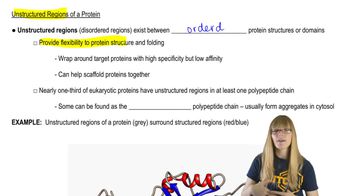
What are unstructured regions in proteins and what is their function?
Unstructured regions, also called disordered regions, provide flexibility and functionality, and can wrap around target proteins or scaffold proteins together.
 Back
Back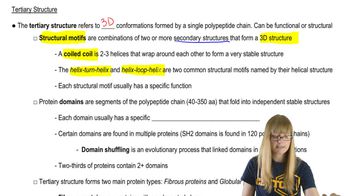
 03:45
03:45