Skip to main content
Cell Biology
My Course
Learn
Exam Prep
AI Tutor
Study Guides
Flashcards
Explore
Try the app
My Course
Learn
Exam Prep
AI Tutor
Study Guides
Flashcards
Explore
Try the app
Back
Transposons and Viruses definitions
You can tap to flip the card.
Mobile Genetic Elements
You can tap to flip the card.
👆
Mobile Genetic Elements
Small DNA segments found in all cells, capable of inserting into various genome locations and driving genetic diversity.
Track progress
Control buttons has been changed to "navigation" mode.
1/15
Related flashcards
Related practice
Recommended videos
Transposons and Viruses quiz
Transposons and Viruses
15 Terms
Transposons and Viruses
4. DNA, Chromosomes, and Genomes
2 problems
Topic
Human Genetic Variation
4. DNA, Chromosomes, and Genomes
5 problems
Topic
4. DNA, Chromosomes, and Genomes - Part 1 of 2
5 topics
14 problems
Chapter
4. DNA, Chromosomes, and Genomes - Part 2 of 2
5 topics
13 problems
Chapter
Guided course
03:14
DNA Transposons
288
views
Guided course
05:25
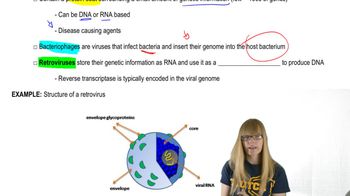
Viruses as Mobile Genetic Elements
241
views
1
rank
Guided course
02:54
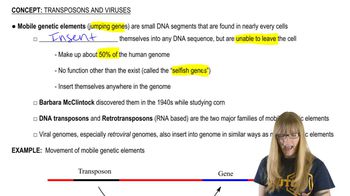
Mobile Genetic Elements
313
views
1
comments
Terms in this set (15)
Hide definitions
Mobile Genetic Elements
Small DNA segments found in all cells, capable of inserting into various genome locations and driving genetic diversity.
Transposon
A DNA sequence that can change its position within the genome, often called a jumping gene.
DNA Transposon
A mobile element moving via a DNA intermediate, typically using a cut-and-paste mechanism.
Retrotransposon
A mobile element moving through an RNA intermediate, requiring reverse transcription to reinsert into DNA.
Reverse Transcriptase
An enzyme that synthesizes DNA from an RNA template, essential for retrotransposon and retrovirus integration.
Inverted Repeat
Short, repeated DNA sequences flanking transposons, crucial for their recognition and movement.
Long Terminal Repeat
Directly repeated sequences, 200–600 base pairs long, flanking certain retrotransposons.
LINE
Long interspersed nuclear element, a type of non-LTR retrotransposon, often several kilobases in length.
SINE
Short interspersed nuclear element, a non-coding retrotransposon, typically around 300 base pairs long.
ALU Element
A highly abundant SINE in the human genome, actively moving and comprising a significant portion of genetic material.
Transposase
A protein encoded by DNA transposons, responsible for excising and relocating the transposon within the genome.
Virus
A simple infectious agent with a protein coat and genetic material, capable of integrating into host genomes.
Bacteriophage
A virus that infects bacteria, often inserting its genome into the bacterial chromosome.
Retrovirus
A virus with an RNA genome that uses reverse transcription to integrate into host DNA.
Integrase
A viral enzyme that facilitates the insertion of viral DNA into the host genome.
 BackBack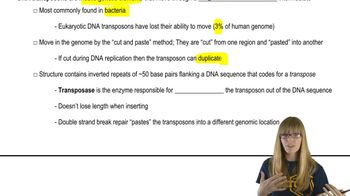
 03:14
03:14