What are mobile genetic elements and where are they found?
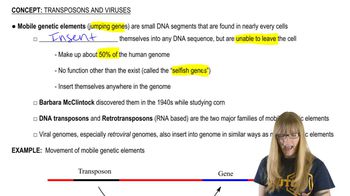
Mobile genetic elements are small DNA segments found in every cell, capable of inserting themselves into any DNA sequence within a cell.
Who discovered mobile genetic elements and in what organism?
Barbara McClintock discovered mobile genetic elements in maize (corn) in the 1940s.
What are the two main types of mobile genetic elements?
The two main types are DNA transposons and retrotransposons.
How do DNA transposons move within the genome?
DNA transposons move through a DNA intermediate using a cut-and-paste mechanism.
What enzyme is encoded by DNA transposons and what is its function?
DNA transposons encode the enzyme transposase, which cuts the transposon out of the DNA sequence.
What is the role of double strand break repair in DNA transposon movement?
Double strand break repair acts as the 'glue' to paste the DNA back together after the transposon is cut out.
How do retrotransposons move within the genome?
Retrotransposons move through an RNA intermediate, which is reverse transcribed into DNA before insertion.
What enzyme is responsible for reverse transcription in retrotransposons?
Reverse transcriptase is the enzyme that converts RNA back into DNA in retrotransposons.
What are long terminal repeat (LTR) retrotransposons and how much of the human genome do they make up?
LTR retrotransposons have long terminal repeats flanking a protein coding region and make up about 8% of the human genome.
What are LINEs and how are they classified?
LINEs (long interspersed elements) are a type of non-LTR retrotransposon, classified into L1, L2, and L3, with only L1 still active.
What are SINEs and what is the most common SINE in humans?
SINEs (short interspersed elements) are short retrotransposons, with the most common being the Alu element.
How do SINEs move if they lack protein coding regions?
SINEs depend on other mobile elements, like LINEs or LTR retrotransposons, to provide necessary proteins for their movement.
How can viral genomes act as mobile genetic elements?
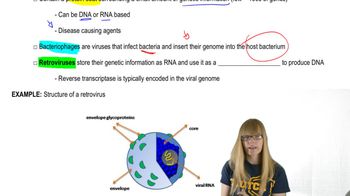
Viral genomes can integrate into the host cell genome, acting as mobile genetic elements by inserting their DNA or RNA-derived DNA.
What enzyme allows viral DNA to integrate into the host genome?
Integrase is the enzyme that inserts viral DNA into the host genome.
How do mobile genetic elements contribute to evolution?
Mobile genetic elements cause mutations by disrupting the genome, playing a major role in evolution and sometimes giving rise to important proteins like transcription factors and telomerase.
 Back
Back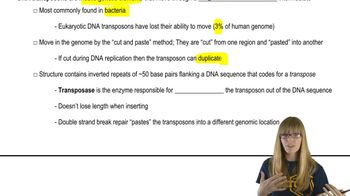
 03:14
03:14