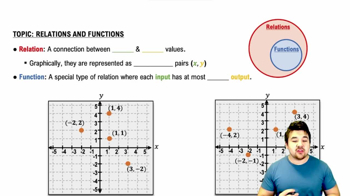
What is the main difference between a relation and a function?
A function is a special type of relation where each input (x-value) has at most one output (y-value), while a relation can have inputs with multiple outputs.
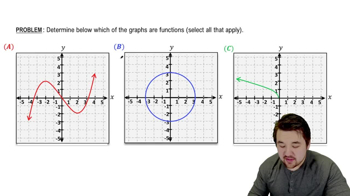
How can you determine if a graph represents a function using the vertical line test?
If any vertical line passes through more than one point on the graph, it is not a function; if every vertical line passes through at most one point, it is a function.
What is the first step when verifying if an equation is a function?
The first step is to solve the equation for y in terms of x.
What does it mean if, after solving for y, a single x-value gives multiple y-values?
It means the equation does not represent a function.
Why is the equation y = 3x - 4 a function?
Because for every x-value, there is exactly one corresponding y-value.
Why is the equation x^2 + y^2 = 25 not a function?
Because for some x-values, there are two possible y-values (one positive and one negative), so it fails the function test.
What is function notation and when can you use it?
Function notation replaces y with f(x) and can only be used if the equation represents a function.
What does the 'squish strategy' help you find on a graph?
Squishing the graph to the x-axis finds the domain, and squishing to the y-axis finds the range.
How do you express the domain and range using interval notation?
Interval notation uses brackets [ ] for included values and parentheses ( ) for excluded values to show the range of x or y values.
What does a closed dot or solid line on a graph indicate about domain or range?
It indicates that the value is included in the domain or range.
What does an open circle on a graph indicate about domain or range?
It means that the value is not included in the domain or range.
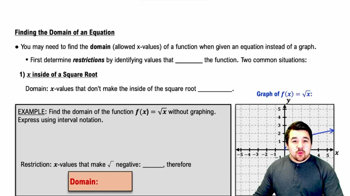
What are two common restrictions when finding the domain of an equation?
You cannot have negative values under a square root or zero in the denominator of a fraction.
What is the domain of f(x) = √x in interval notation?
The domain is [0, ∞), meaning x must be greater than or equal to 0.
What is the domain of f(x) = 2/(x - 5) in interval notation?
The domain is (-∞, 5) ∪ (5, ∞), meaning all real numbers except x = 5.
When do you use a union symbol (∪) in interval notation for domain or range?
You use a union symbol when the domain or range consists of multiple, separate intervals.
 Back
Back
 3:43
3:43