Skip to main content
College Algebra
My Course
Learn
Exam Prep
AI Tutor
Study Guides
Textbook Solutions
Flashcards
Explore
Try the app
My Course
Learn
Exam Prep
AI Tutor
Study Guides
Textbook Solutions
Flashcards
Explore
Try the app
Back
Multiplying Polynomials quiz
1 student found this helpful
You can tap to flip the card.
What does the FOIL acronym stand for when multiplying two binomials?
You can tap to flip the card.
👆
What does the FOIL acronym stand for when multiplying two binomials?
FOIL stands for First, Outer, Inner, Last, which are the pairs of terms you multiply together in order.
Track progress
Control buttons has been changed to "navigation" mode.
1/15
Related flashcards
Related practice
Recommended videos
Multiplying Polynomials definitions
Multiplying Polynomials
15 Terms
Multiplying Polynomials
0. Review of Algebra
3 problems
Topic
Callie
Factoring Polynomials
0. Review of Algebra
7 problems
Topic
Callie
0. Review of Algebra - Part 1 of 2
5 topics
10 problems
Chapter
Callie
0. Review of Algebra - Part 2 of 2
3 topics
10 problems
Chapter
Callie
Guided course
03:41
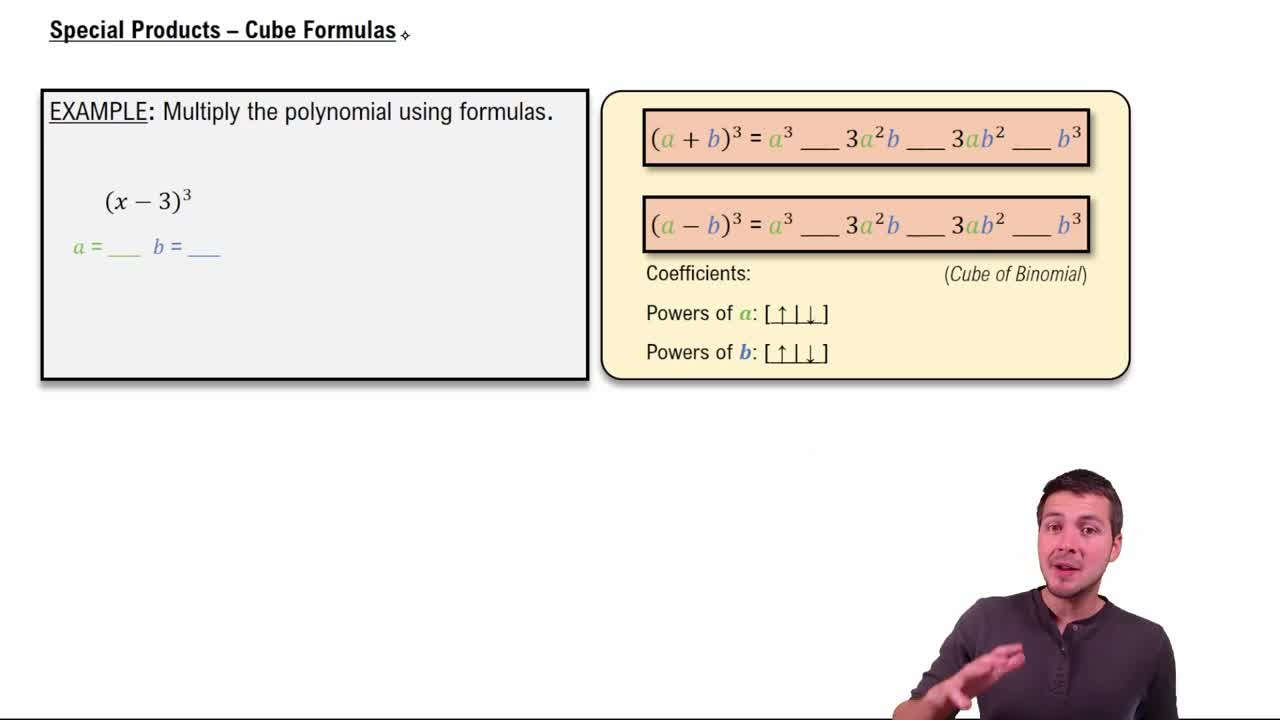
Special Products - Cube Formulas
2581
views
47
rank
1
comments
Guided course
04:14
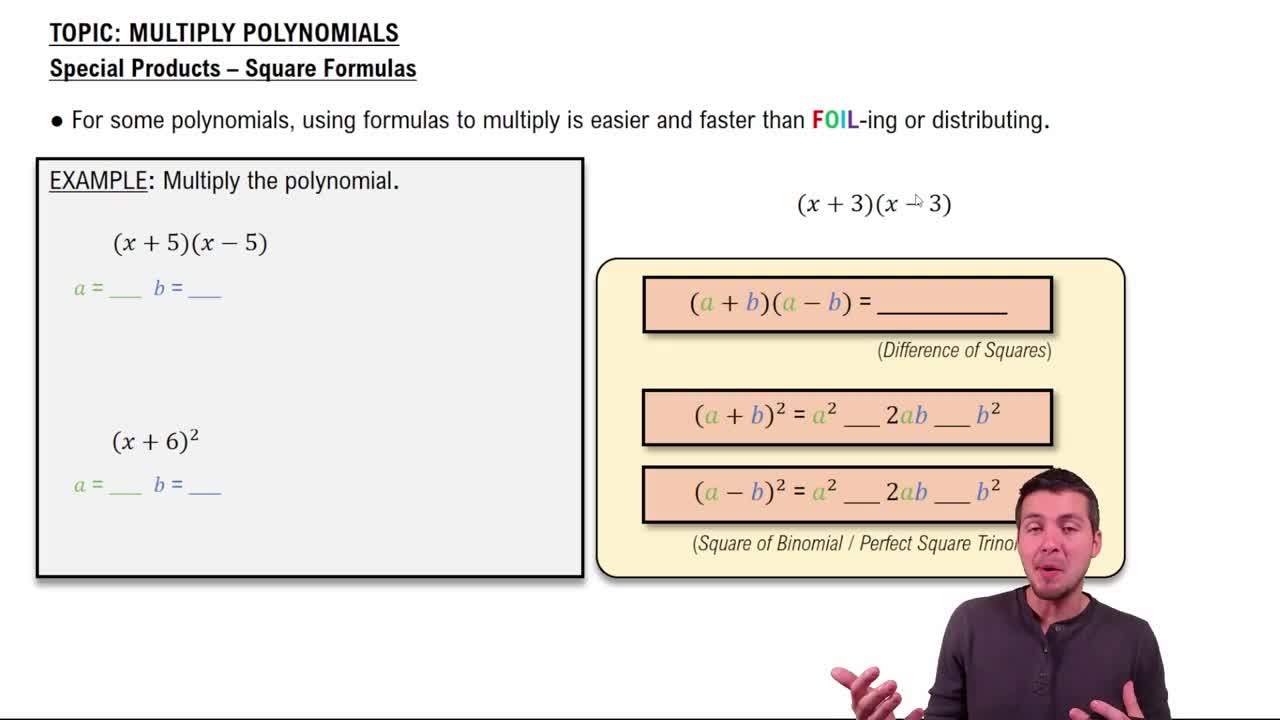
Special Products - Square Formulas
2761
views
49
rank
Guided course
03:07
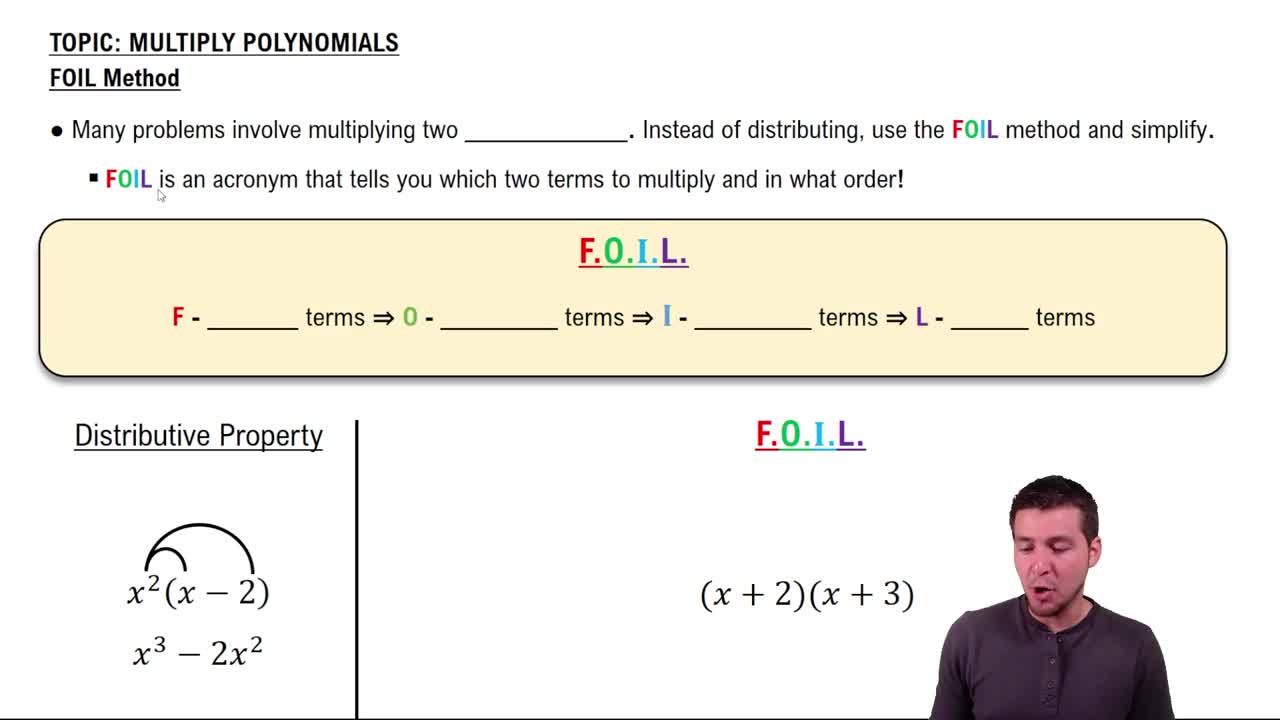
FOIL
4299
views
125
rank
Terms in this set (15)
Hide definitions
What does the FOIL acronym stand for when multiplying two binomials?
FOIL stands for First, Outer, Inner, Last, which are the pairs of terms you multiply together in order.
When can you use the FOIL method for multiplying polynomials?
You can use FOIL only when multiplying two binomials (expressions with exactly two terms each).
What is the result of multiplying (x + 2)(x + 3) using FOIL?
The result is x^2 + 5x + 6 after combining like terms.
Why can't you use FOIL to multiply a binomial by a trinomial?
FOIL only works for two-term by two-term multiplication; for more terms, you must use the distributive property.
How do you multiply a binomial by a trinomial?
Break the binomial into two distributive problems, multiply each term by the entire trinomial, and then combine like terms.
What is a quick way to check if you multiplied polynomials correctly before simplifying?
Multiply the number of terms in each polynomial; the product is the number of terms you should have before combining like terms.
What is the special product formula for the difference of squares?
The formula is (A + B)(A - B) = A^2 - B^2.
What pattern do you notice in the middle terms when multiplying (A + B)(A - B)?
The middle terms always cancel out, leaving only A^2 - B^2.
What is the formula for the square of a binomial (A + B)^2?
The formula is (A + B)^2 = A^2 + 2AB + B^2.
How do you expand (x + 6)^2 using the special product formula?
It expands to x^2 + 12x + 36.
What is the formula for the cube of a binomial (A - B)^3?
The formula is (A - B)^3 = A^3 - 3A^2B + 3AB^2 - B^3.
How do the signs alternate in the expansion of (A - B)^3?
The signs alternate as negative, positive, negative: -, +, -.
What are the coefficients in the expansion of a binomial cube (A ± B)^3?
The coefficients are always 1, 3, 3, and 1.
How do the powers of A and B change in the expansion of (A + B)^3?
The powers of A decrease from 3 to 0, while the powers of B increase from 0 to 3.
Why is recognizing patterns in polynomial multiplication useful?
Recognizing patterns allows you to use shortcuts and special product formulas, making calculations faster and less complex.
 BackBack
 03:41
03:41