Skip to main content
College Algebra
My Course
Learn
Exam Prep
AI Tutor
Study Guides
Textbook Solutions
Flashcards
Explore
Try the app
My Course
Learn
Exam Prep
AI Tutor
Study Guides
Textbook Solutions
Flashcards
Explore
Try the app
Back
Quadratic Functions quiz
You can tap to flip the card.
What is the standard form of a quadratic function?
You can tap to flip the card.
👆
What is the standard form of a quadratic function?
The standard form is f(x) = ax^2 + bx + c, where a, b, and c are real numbers and a ≠ 0.
Track progress
Control buttons has been changed to "navigation" mode.
1/15
Related flashcards
Related practice
Recommended videos
Quadratic Functions definitions
Quadratic Functions
15 Terms
Quadratic Functions
4. Polynomial Functions
4 problems
Topic
Callie
Understanding Polynomial Functions
4. Polynomial Functions
3 problems
Topic
Callie
4. Polynomial Functions
5 topics
11 problems
Chapter
Callie
Guided course
04:34
Converting Standard Form to Vertex Form
3360
views
52
rank
1
comments
Guided course
08:07
Vertex Form
3969
views
137
rank
1
comments
Guided course
7:49
Example 2
2336
views
59
rank
1
comments
Terms in this set (15)
Hide definitions
What is the standard form of a quadratic function?
The standard form is f(x) = ax^2 + bx + c, where a, b, and c are real numbers and a ≠ 0.
What shape does the graph of a quadratic function always take?
The graph is always a parabola, which can open upwards or downwards.
How do you determine if the vertex of a parabola is a minimum or maximum?
If the parabola opens upward (a > 0), the vertex is a minimum; if it opens downward (a < 0), the vertex is a maximum.
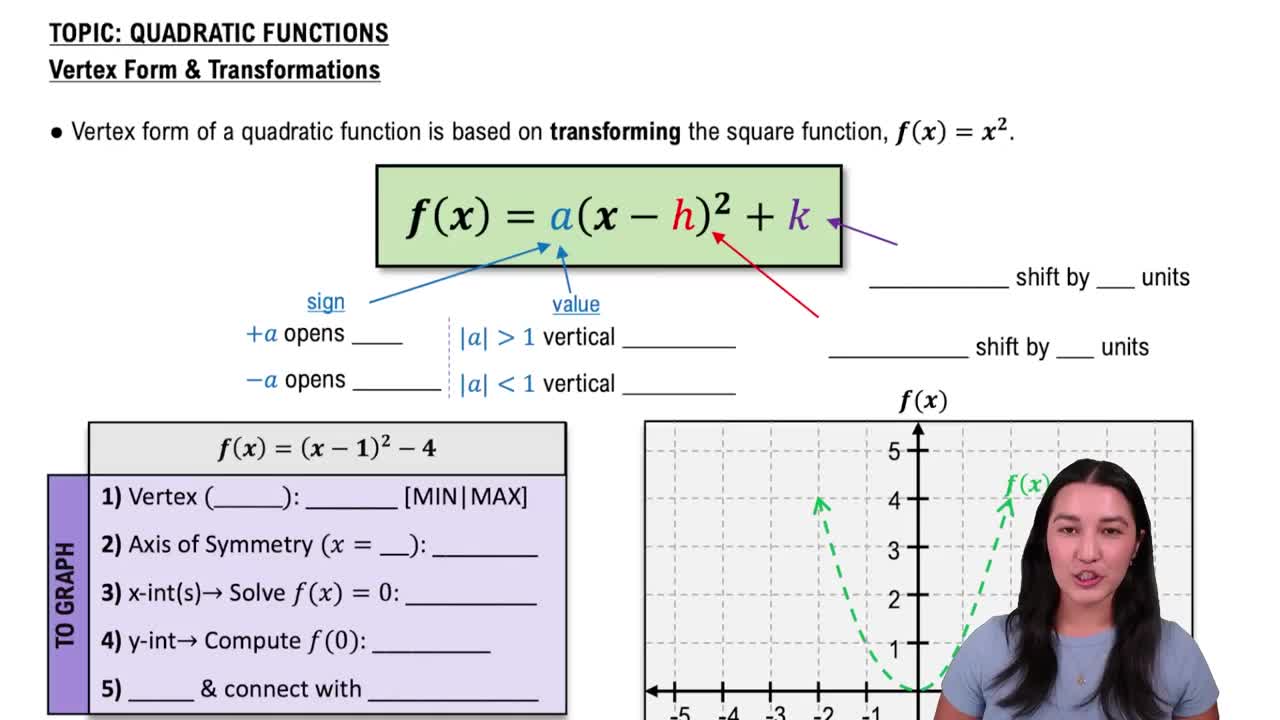
What is the axis of symmetry for a parabola in vertex form?
The axis of symmetry is the vertical line x = h, where (h, k) is the vertex.
How many x-intercepts can a quadratic function have?
A quadratic function can have one or two x-intercepts, but never more or less.
What is the domain of any quadratic function?
The domain is all real numbers, written as (−∞, ∞).
How does the value of 'a' in vertex form affect the parabola's width?
If |a| > 1, the parabola is vertically stretched (narrower); if |a| < 1, it is vertically compressed (wider).
What does the 'h' value in vertex form indicate?
The 'h' value indicates a horizontal shift of the parabola by h units.
How do you find the y-intercept of a quadratic function?
Plug x = 0 into the function and solve for f(0).
What is the vertex of a quadratic function in vertex form f(x) = a(x-h)^2 + k?
The vertex is the point (h, k).
How do you find the x-intercepts of a quadratic function in vertex form?
Set f(x) = 0 and solve for x, often using the square root property.
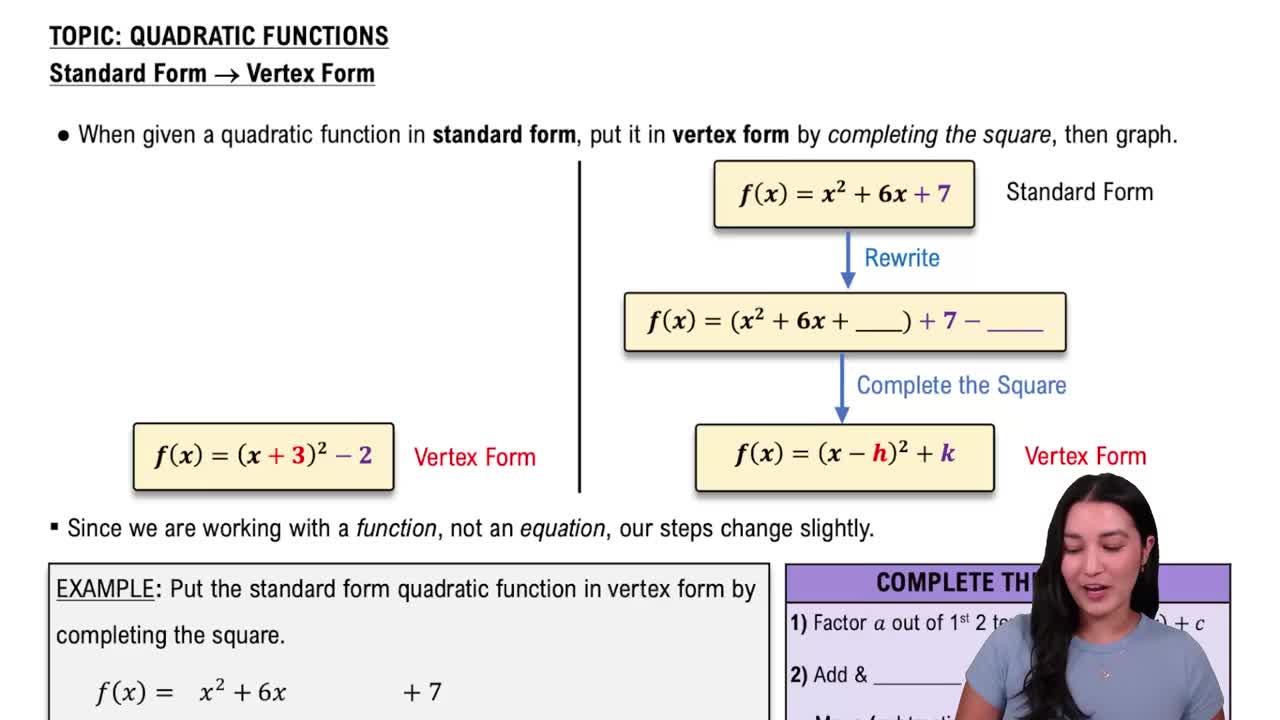
What is the process called for converting standard form to vertex form?
The process is called completing the square.
What is the range of a quadratic function with a minimum at y = k?
The range is [k, ∞) if the parabola opens upward.
How do you determine the intervals where a quadratic function is increasing or decreasing?
The vertex divides the intervals; the function increases on one side of the vertex and decreases on the other.
What steps are involved in completing the square for f(x) = ax^2 + bx + c?
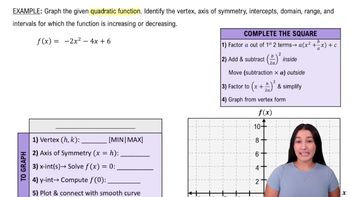
Factor out a from the x terms, add and subtract (b/2a)^2 inside the parentheses, move the subtracted term outside, and rewrite in vertex form.
 BackBack
 04:34
04:34