Skip to main content
Financial Accounting
My Course
Learn
Exam Prep
AI Tutor
Study Guides
Flashcards
Explore
Try the app
My Course
Learn
Exam Prep
AI Tutor
Study Guides
Flashcards
Explore
Try the app
Back
GAAP vs. IFRS: Adjusting Entries definitions
You can tap to flip the card.
GAAP
You can tap to flip the card.
👆
GAAP
U.S. accounting framework established by FASB, emphasizing consistency and comparability in financial reporting.
Track progress
Control buttons has been changed to "navigation" mode.
1/15
Related flashcards
Related practice
Recommended videos
GAAP vs. IFRS: Adjusting Entries quiz
GAAP vs. IFRS: Adjusting Entries
15 Terms
GAAP vs. IFRS: Adjusting Entries
15. GAAP vs IFRS
10 problems
Topic
GAAP vs. IFRS: Merchandising
15. GAAP vs IFRS
10 problems
Topic
15. GAAP vs IFRS
11 topics
11 problems
Chapter
Guided course
04:03
GAAP vs. IFRS: Adjusting Entries
400
views
10
rank
Terms in this set (15)
Hide definitions
GAAP
U.S. accounting framework established by FASB, emphasizing consistency and comparability in financial reporting.
IFRS
International accounting standards set by IASB, focusing on global comparability and often allowing asset revaluation.
FASB
U.S. organization responsible for developing and updating generally accepted accounting principles.
IASB
International body that creates and maintains standards for financial reporting used outside the U.S.
Accrual Accounting
Method requiring revenues and expenses to be recorded when earned or incurred, not when cash is exchanged.
Periodicity Assumption
Concept of dividing a business's ongoing activities into artificial time periods for reporting purposes.
Adjusting Entries
End-of-period journal entries ensuring revenues and expenses are recorded in the correct accounting period.
Revenue Recognition
Guideline dictating when and how income is formally recorded in the financial statements.
Fair Value Principle
IFRS guideline allowing assets to be reported at current market value, impacting asset valuation and depreciation.
Depreciation
Systematic allocation of the cost of a long-term asset over its useful life.
Revaluation
IFRS-permitted process of adjusting the book value of long-term assets to reflect current fair market value.
Expense
Outflow or using up of assets in the normal course of business operations.
Loss
Financial decrease from events outside normal business activities, such as selling investments below cost.
Long-term Asset
Resource expected to provide economic benefit to a business for more than one year, subject to depreciation.
Balance Sheet
Financial statement presenting a company's assets, liabilities, and equity at a specific point in time.
 BackBack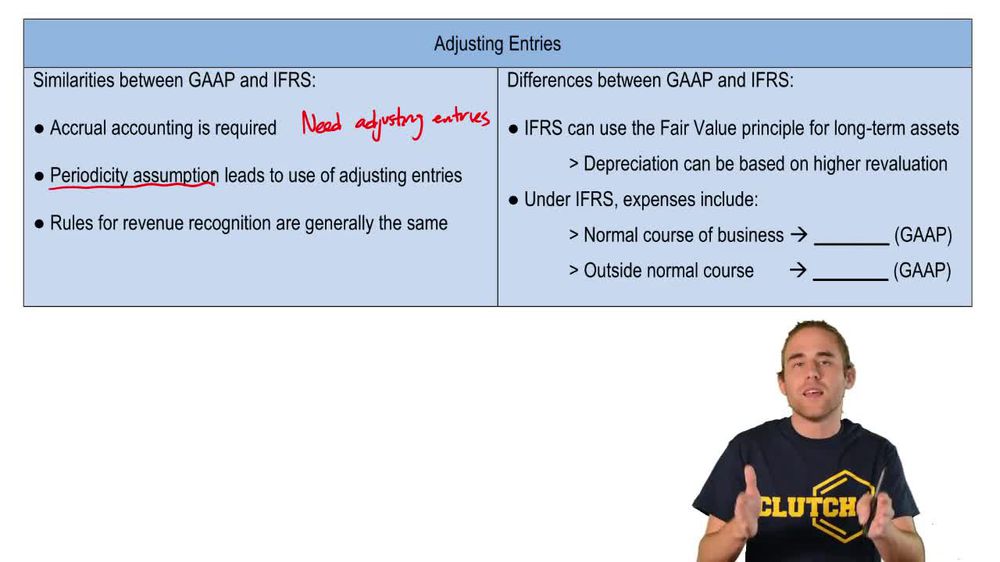
 04:03
04:03