Skip to main content
Financial Accounting
My Course
Learn
Exam Prep
AI Tutor
Study Guides
Flashcards
Explore
Try the app
My Course
Learn
Exam Prep
AI Tutor
Study Guides
Flashcards
Explore
Try the app
Back
Ratios: Average Days in Inventory definitions
You can tap to flip the card.
Average Days in Inventory
You can tap to flip the card.
👆
Average Days in Inventory
Represents the typical number of days a unit remains in stock before being sold, reflecting how efficiently inventory is managed.
Track progress
Control buttons has been changed to "navigation" mode.
1/14
Related flashcards
Related practice
Recommended videos
Ratios: Average Days in Inventory quiz #1
Ratios: Average Days in Inventory
12 Terms
Ratios: Average Days in Inventory
14. Financial Statement Analysis
10 problems
Topic
Ratios: Accounts Receivable (AR) Turnover
14. Financial Statement Analysis
10 problems
Topic
14. Financial Statement Analysis
15 topics
15 problems
Chapter
Guided course
06:34
Ratios: Average Days in Inventory
833
views
8
rank
Terms in this set (14)
Hide definitions
Average Days in Inventory
Represents the typical number of days a unit remains in stock before being sold, reflecting how efficiently inventory is managed.
Efficiency Ratio
A metric used to assess how effectively a company utilizes its resources, such as inventory, to generate sales.
Inventory Turnover Ratio
Shows how many times inventory is sold and replaced during a period, calculated as cost of goods sold divided by average inventory.
Cost of Goods Sold
Total direct costs attributable to the production of goods sold by a company during a specific period.
Average Inventory
The mean value of inventory held, found by adding beginning and ending inventory balances and dividing by two.
Beginning Inventory
The value of inventory a company has at the start of an accounting period, used in calculating average inventory.
Ending Inventory
The value of inventory remaining at the end of an accounting period, essential for average inventory calculations.
Benchmarking
The process of comparing a company's performance metrics, like days in inventory, to industry standards or competitors.
Industry Standards
Commonly accepted performance metrics within a specific sector, used as reference points for comparison.
Warehouse Duration Costs
Expenses incurred from storing inventory, including rent and utilities, which increase with longer storage times.
Numerator
The top part of a fraction in ratio calculations, such as cost of goods sold in the inventory turnover ratio.
Denominator
The bottom part of a fraction in ratio calculations, such as average inventory in the inventory turnover ratio.
Reciprocal Relationship
A connection where one value increases as the other decreases, as seen between inventory turnover and days in inventory.
Net Sales
Total revenue from sales after deducting returns, allowances, and discounts, sometimes provided but not used in inventory turnover calculations.
 BackBack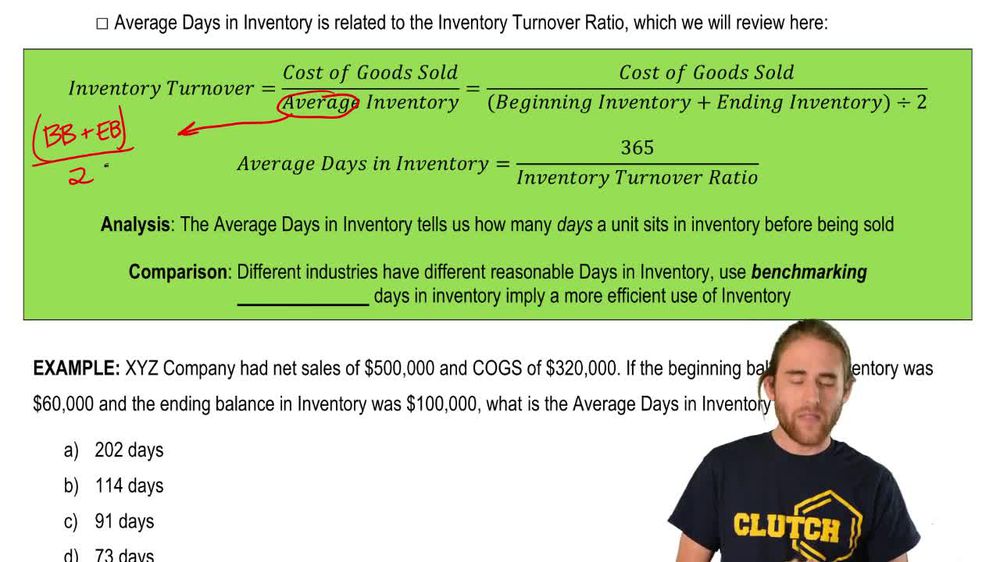
 06:34
06:34