Skip to main content
Financial Accounting
My Course
Learn
Exam Prep
AI Tutor
Study Guides
Flashcards
Explore
Try the app
My Course
Learn
Exam Prep
AI Tutor
Study Guides
Flashcards
Explore
Try the app
Back
Ratios: Return on Equity (ROE) definitions
You can tap to flip the card.
Return on Equity
You can tap to flip the card.
👆
Return on Equity
Profitability ratio showing how much net income is generated for each dollar of common equity, typically expressed as a percentage.
Track progress
Control buttons has been changed to "navigation" mode.
1/15
Related flashcards
Related practice
Recommended videos
Ratios: Return on Equity (ROE) quiz #1
Ratios: Return on Equity (ROE)
10 Terms
Ratios: Return on Equity (ROE)
14. Financial Statement Analysis
10 problems
Topic
Ratios: DuPont Model for Return on Equity (ROE)
14. Financial Statement Analysis
10 problems
Topic
14. Financial Statement Analysis
15 topics
15 problems
Chapter
Guided course
04:58
Ratios: Return on Equity (ROE)
941
views
10
rank
Terms in this set (15)
Hide definitions
Return on Equity
Profitability ratio showing how much net income is generated for each dollar of common equity, typically expressed as a percentage.
Net Income
Amount remaining after all expenses, taxes, and costs are subtracted from total revenue during a specific period.
Average Common Equity
Mean value of common equity over a period, calculated by adding beginning and ending balances and dividing by two.
Common Equity
Portion of stockholders' equity attributable to common shareholders, excluding any amounts related to preferred stock.
Preferred Stock
Class of ownership with priority over common stock for dividends and assets, excluded from common equity calculations.
Profitability Ratio
Financial metric used to assess a company's ability to generate earnings relative to equity, assets, or other financial elements.
Leverage
Extent to which a company uses debt compared to equity in its capital structure, influencing both risk and potential returns.
Debt Financing
Method of raising capital by borrowing funds, increasing financial risk but potentially boosting returns for equity holders.
Equity Financing
Raising funds by issuing shares of stock, resulting in ownership dilution but no obligation for repayment.
Stockholders' Equity
Total value of assets remaining after liabilities are subtracted, representing ownership interest in a company.
Assets
Resources owned by a company, financed through a combination of liabilities and equity.
Liabilities
Obligations or debts a company must repay, including loans and other forms of borrowed money.
Net Loss
Situation where total expenses exceed total revenues, resulting in negative income for a period.
Percentage Return
Expression of a ratio as a percent, indicating the proportion of income earned relative to equity invested.
High Risk High Reward
Scenario where increased financial leverage can lead to greater returns for equity holders but also amplifies potential losses.
 BackBack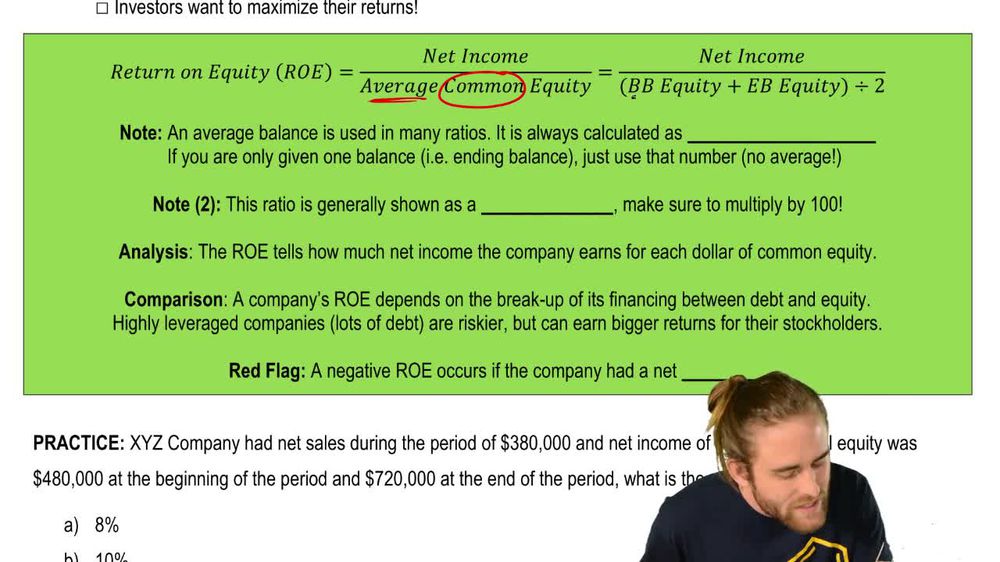
 04:58
04:58