Skip to main content
Financial Accounting
My Course
Learn
Exam Prep
AI Tutor
Study Guides
Flashcards
Explore
Try the app
My Course
Learn
Exam Prep
AI Tutor
Study Guides
Flashcards
Explore
Try the app
Back
Ratios: Working Capital and the Current Ratio definitions
You can tap to flip the card.
Current Ratio
You can tap to flip the card.
👆
Current Ratio
A liquidity measure showing how many dollars of current assets are available for each dollar of current liabilities.
Track progress
Control buttons has been changed to "navigation" mode.
1/15
Related flashcards
Related practice
Recommended videos
Ratios: Working Capital and the Current Ratio quiz #1
Ratios: Working Capital and the Current Ratio
10 Terms
Ratios: Working Capital and the Current Ratio
14. Financial Statement Analysis
10 problems
Topic
Ratios: Quick (Acid Test) Ratio
14. Financial Statement Analysis
10 problems
Topic
14. Financial Statement Analysis
15 topics
15 problems
Chapter
Guided course
07:11
Ratios: Working Capital and the Current Ratio
1966
views
39
rank
Terms in this set (15)
Hide definitions
Current Ratio
A liquidity measure showing how many dollars of current assets are available for each dollar of current liabilities.
Working Capital
A dollar amount representing the excess of current assets over current liabilities, indicating short-term financial health.
Liquidity Ratio
A financial metric assessing a company's ability to meet short-term obligations using assets easily converted to cash.
Current Assets
Resources expected to be converted to cash or used up within one year, such as cash, inventory, and receivables.
Current Liabilities
Obligations due to be settled within one year, including accounts payable and short-term debt.
Short-term Financial Stability
A company's capacity to cover its immediate obligations, often indicated by positive working capital and a current ratio above 1.
Negative Working Capital
A situation where current liabilities exceed current assets, signaling potential short-term financial problems.
Positive Working Capital
A condition where current assets surpass current liabilities, reflecting an ability to meet short-term debts.
Asset Management Efficiency
The effectiveness with which a company utilizes its assets, with excessive working capital possibly indicating inefficiency.
Fixed Assets
Long-term resources such as property or equipment, not intended for quick conversion to cash.
Financial Analysis
The process of evaluating financial data, such as ratios, to assess a company's performance and stability.
Liquidity Problems
Difficulties in meeting short-term obligations, often signaled by a current ratio below 1 or negative working capital.
Dollar Amount
A specific monetary value, such as the result of working capital calculation, representing the difference between assets and liabilities.
Short-term Obligations
Debts or payments due within one year, typically covered by current assets.
Financial Metric
A quantitative measure, such as a ratio or difference, used to evaluate aspects of a company's financial health.
 BackBack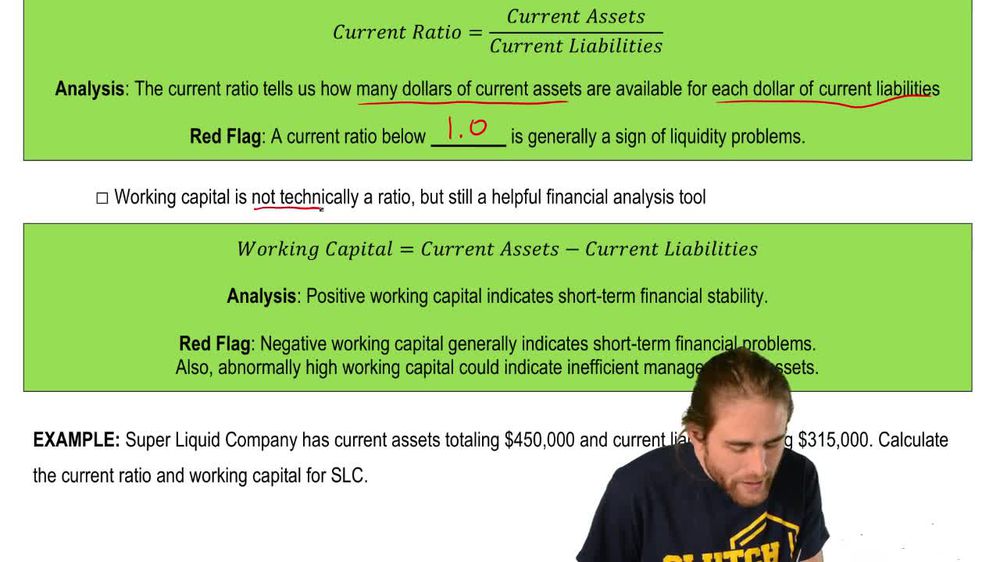
 07:11
07:11