Skip to main content
Financial Accounting
My Course
Learn
Exam Prep
AI Tutor
Study Guides
Flashcards
Explore
Try the app
My Course
Learn
Exam Prep
AI Tutor
Study Guides
Flashcards
Explore
Try the app
Back
Types of Liabilities definitions
You can tap to flip the card.
Current Liabilities
You can tap to flip the card.
👆
Current Liabilities
Obligations that must be settled within one year, often covering routine business expenses and short-term debts.
Track progress
Control buttons has been changed to "navigation" mode.
1/14
Related flashcards
Related practice
Recommended videos
Types of Liabilities definitions
Types of Liabilities
14 Terms
Types of Liabilities quiz #1
Types of Liabilities
25 Terms
Types of Liabilities
9. Current Liabilities
10 problems
Topic
Notes Payable
9. Current Liabilities
10 problems
Topic
9. Current Liabilities
7 topics
15 problems
Chapter
Guided course
08:17
Types of Liabilities
2035
views
53
rank
Terms in this set (14)
Hide definitions
Current Liabilities
Obligations that must be settled within one year, often covering routine business expenses and short-term debts.
Accounts Payable
Amounts owed to suppliers for goods or services received but not yet paid, representing day-to-day operational debts.
Accrued Expenses
Liabilities from expenses incurred but not yet paid, typically recorded through adjusting entries like salaries or interest.
Salaries Payable
Amounts owed to employees for work performed but not yet paid by the end of an accounting period.
Interest Payable
Unpaid interest costs that have accumulated on borrowed funds and are due in the near future.
Taxes Payable
Obligations for taxes that have been incurred but not yet remitted to tax authorities.
Unearned Revenues
Advance payments received from customers for goods or services not yet delivered, creating an obligation to perform.
Deferred Revenues
Alternative term for unearned revenues, representing customer payments received before earning the related income.
Payroll Liabilities
Employer obligations related to employee compensation, including taxes and benefits such as social security and health insurance.
Current Maturities of Long-Term Debt
Portion of long-term loans that must be repaid within the current year, such as upcoming mortgage payments.
Long-Term Liabilities
Obligations not due within one year, often involving significant financing arrangements like loans or bonds.
Notes Payable
Formal written promises to repay borrowed money, usually from banks, often with interest and over periods longer than one year.
Bonds Payable
Debt instruments issued to multiple lenders, allowing organizations to raise large sums by borrowing from many investors.
Customer Deposits
Funds received from customers in advance, creating a liability until the related goods or services are provided.
 BackBack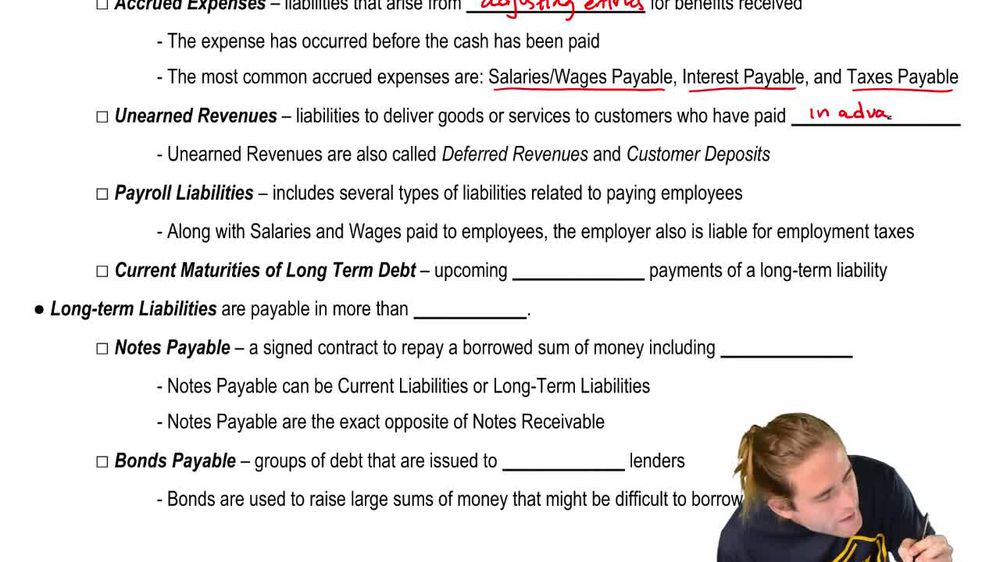
 08:17
08:17