
Textbook Question
Based on effective nuclear charge (Zeff), which ion is the strongest oxidizing agent?
(a) Cu2+
(b) Ni2+
(c) Fe2+
(d) Mn2+
106
views

 Verified step by step guidance
 01:33
01:33
 04:44
04:44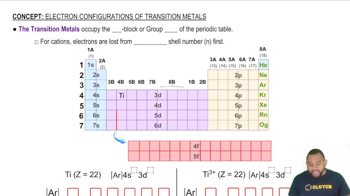 03:12
03:12Based on effective nuclear charge (Zeff), which ion is the strongest oxidizing agent?
(a) Cu2+
(b) Ni2+
(c) Fe2+
(d) Mn2+
The oxalate ion is a bidentate ligand as indicated in Figure 21.8. Would you expect the carbonate ion to be a monodentate or bidentate ligand? Explain your reasoning.
Although Cl- is a weak-field ligand and CN- is a strong field ligand, [CrCl6]3- and [Cr(CN)6]3- exhibit approximately the same amount of paramagnetism. Explain.
Which of the following complexes can exist as diastereoisomers?
(a) [Cr(NH3)2Cl4]-
(b) [Co(NH3)5Br]2+
(c) [MnCl2Br2]2- (tetrahedral)
(d) [Pt(NH3)2Br2]2-
What is the crystal field energy level diagram for the complex [Fe(NH3)6]3+?
(a)
(b)
(c)
(d)
What is the general trend in standard potentials for the oxidation of first-series transition metals from Sc to Zn? What is the reason for the trend?