

Sodium reacts with oxygen in air to form two compounds: sodium oxide and sodium peroxide. In forming sodium oxide, 23.0 g of sodium combines with 8.0 g of hydrogen. In forming sodium peroxide, 23.0 g of sodium combines with 16.0 g of oxygen. (a) What are the mass ratios of oxygen in the two compounds?
A 1.0-g sample of carbon dioxide (CO2) is fully decomposed into its elements, yielding 0.273 g of carbon and 0.727 g of oxygen. (a) What is the ratio of the mass of O to C?
Verified step by step guidance
Verified video answer for a similar problem:
Key Concepts
Mass Ratio
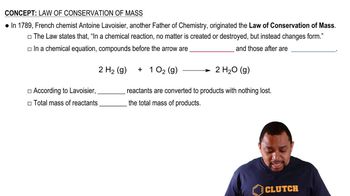
Law of Conservation of Mass
Stoichiometry
A chemist finds that 30.82 g of nitrogen will react with 17.60, 35.20, 70.40, or 88.00 g of oxygen to form four different compounds. (a) Calculate the mass of oxygen per gram of nitrogen in each compound. 30.82 g N and 70.40 g O
Sodium reacts with oxygen in air to form two compounds: sodium oxide and sodium peroxide. In forming sodium oxide, 23.0 g of sodium combines with 8.0 g of hydrogen. In forming sodium peroxide, 23.0 g of sodium combines with 16.0 g of oxygen. (b) What fundamental law does this experiment demonstrate?
Five of the boxes in the following periodic table are colored. Predict the charge on the ion associated with each of these elements.
In the Millikan oil-drop experiment (see Figure 2.5), the tiny oil drops are observed through the viewing lens as rising, stationary, or falling, as shown here. (a) What causes their rate of fall to vary from their rate in the absence of an electric field?
