This graph shows a plot of the rate of a reaction versus the concentration of the reactant A for the reaction A → products. c. Write a rate law for the reaction including an estimate for the value of k.
Ch.14 - Chemical Kinetics
Chapter 14, Problem 34c
Consider the reaction: 2 H2O2(aq) → 2 H2O(l ) + O2( g) The graph shows the concentration of H2O2 as a function of time.
Use the graph to calculate each quantity: c. the instantaneous rate of formation of O2 at 50 s
Verified step by step guidance1
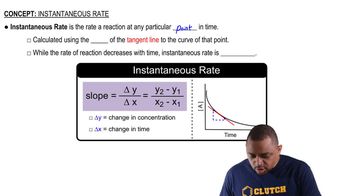
Determine the slope of the tangent line to the curve at 50 seconds on the graph of H_2O_2 concentration versus time.
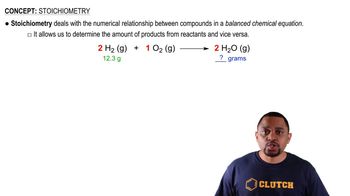
Use the stoichiometry of the reaction: 2 H_2O_2(aq) → 2 H_2O(l) + O_2(g) to relate the rate of disappearance of H_2O_2 to the rate of formation of O_2.
The rate of formation of O_2 is half the rate of disappearance of H_2O_2, due to the stoichiometric coefficients in the balanced equation.
Calculate the instantaneous rate of formation of O_2 by taking half of the slope determined in the first step.
Express the rate in appropriate units, typically mol/L·s, based on the units used in the graph.

Verified video answer for a similar problem:
This video solution was recommended by our tutors as helpful for the problem above.
Video duration:
4mWas this helpful?
Key Concepts
Here are the essential concepts you must grasp in order to answer the question correctly.
Reaction Rate
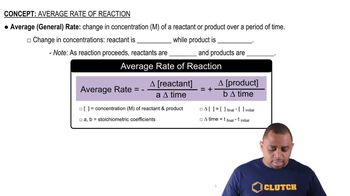
The reaction rate refers to the speed at which reactants are converted into products in a chemical reaction. It can be expressed as the change in concentration of a reactant or product over time. Understanding how to calculate reaction rates is essential for analyzing chemical kinetics and determining how quickly a reaction proceeds.
Recommended video:
Guided course
Average Rate of Reaction
Instantaneous Rate
The instantaneous rate of a reaction is the rate at a specific moment in time, rather than over an interval. It can be determined by taking the slope of the tangent line to the concentration vs. time graph at the desired time point. This concept is crucial for accurately assessing how fast a product is being formed or a reactant is being consumed at any given moment.
Recommended video:
Guided course
Instantaneous Rate
Stoichiometry
Stoichiometry involves the quantitative relationships between the reactants and products in a chemical reaction, based on the balanced chemical equation. In the given reaction, the stoichiometric coefficients indicate that for every 2 moles of H2O2 decomposed, 1 mole of O2 is produced. This relationship is vital for converting the rate of formation of one substance into the rate of formation of another.
Recommended video:
Guided course
Stoichiometry Concept
Related Practice
Textbook Question
1703
views
Textbook Question
This graph shows a plot of the rate of a reaction versus the concentration of the reactant A for the reaction A → products. a. What is the order of the reaction with respect to A?
535
views
Textbook Question
Consider the reaction: 2 H2O2(aq) → 2 H2O(l ) + O2( g) The graph shows the concentration of H2O2 as a function of time. Use the graph to calculate each quantity: d. If the initial volume of the H2O2 is 1.5 L, what total amount of O2 (in moles) is formed in the first 50 s of reaction?
1319
views
Textbook Question
Consider the reaction: H2( g) + Br2( g) → 2 HBr( g) The graph shows the concentration of Br2 as a function of time.
b. Make a rough sketch of a curve representing the concentration of HBr as a function of time. Assume that the initial concentration of HBr is zero
750
views