Back

Alkane Reactions quiz

Control buttons has been changed to "navigation" mode.
1/15
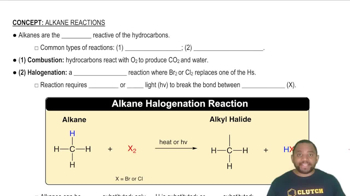
  • What are the two major types of reactions that alkanes undergo?

    Alkanes primarily undergo combustion and halogenation reactions.
  • What are the products of the combustion of an alkane with oxygen?

    Combustion of an alkane with oxygen produces carbon dioxide, water, and energy.
  • What is halogenation in the context of alkane reactions?

    Halogenation is a substitution reaction where a halogen replaces a hydrogen atom on an alkane.
  • Which halogens are commonly used in the halogenation of alkanes?

    Chlorine (Cl₂) and bromine (Br₂) are commonly used in alkane halogenation.
  • What conditions are required for the halogenation of alkanes?

    Halogenation of alkanes requires heat or ultraviolet (UV) light.
  • What is the general formula for the halogenation of methane?

    CH₄ + X₂ → CH₃X + HX, where X is a halogen like Cl or Br.
  • What does 'mono-substituted' mean in alkane halogenation?

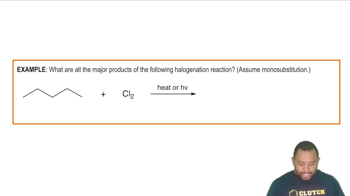
    Mono-substituted means only one hydrogen atom is replaced by a halogen.
  • What does 'poly-substituted' mean in alkane halogenation?

    Poly-substituted means more than one hydrogen atom is replaced by halogens.
  • What is the product called when a halogen replaces a hydrogen in an alkane?

    The product is called an alkyl halide.
  • What role does UV light play in the halogenation of alkanes?

    UV light helps break the bond between halogen atoms, initiating the reaction.
  • What happens to the hydrogen atom that is replaced during halogenation?

    The hydrogen atom combines with a halogen atom to form HX, such as HCl or HBr.
  • Why are alkanes considered the least reactive hydrocarbons?

    Alkanes have strong C-H and C-C bonds, making them less reactive than other hydrocarbons.
  • What is represented by 'hv' in alkane halogenation reactions?

    'hv' represents ultraviolet light used to initiate the reaction.
  • In the reaction CH₄ + Cl₂ → CH₃Cl + HCl, what type of reaction is this?

    This is a halogenation reaction, specifically a mono-substitution.
  • Why is it important to know if a question asks for a mono or poly product in halogenation?

    Because the number of hydrogens replaced by halogens affects the products formed.