Atomic, Ionic, and Molecular Solids definitions Flashcards

Atomic, Ionic, and Molecular Solids definitions
Control buttons has been changed to "navigation" mode.
1/15
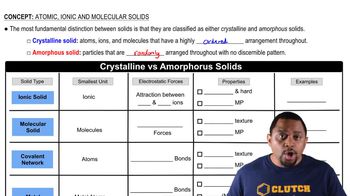
  • Crystalline Solids
    Solids with highly ordered arrangements of atoms, ions, or molecules.
  • Amorphous Solids
    Solids with randomly arranged particles and no discernible pattern.
  • Ionic Solids
    Solids formed from cations and anions with high melting points and brittleness.
  • Molecular Solids
    Solids composed of molecules bonded by intermolecular forces, generally soft.
  • Covalent Network Solids
    Solids with atoms linked by covalent bonds, extremely hard with high melting points.
  • Metals
    Solids with metallic bonds, ranging from soft to hard, often lustrous.
  • Polymers
    Large molecules composed of repeating structural units, often found in plastics.
  • Electrostatic Forces
    Forces of attraction between charged particles, crucial in ionic and molecular solids.
  • Intermolecular Forces
    Forces between molecules affecting the properties of molecular solids.
  • Covalent Bonds
    Strong bonds formed by sharing electrons between atoms, found in covalent networks.
  • Metallic Bonds
    Bonds formed by the pooling of electrons among metal atoms.
  • Lustrous
    Having a shiny appearance, a characteristic of many metals.
  • Melting Point
    The temperature at which a solid becomes a liquid.
  • Graphite
    A form of carbon with a layered structure, used in pencils.
  • Tar
    A black, sticky substance used on roads, an example of an amorphous solid.