Atomic, Ionic, and Molecular Solids quiz #1 Flashcards

Atomic, Ionic, and Molecular Solids quiz #1
1 student found this helpful
Control buttons has been changed to "navigation" mode.
1/10
  • Which type of solid has the highest melting point?
    Covalent network solids have the highest melting points due to their strong covalent bonds throughout the structure; diamond is a prime example.
  • Which type of solid does not have a precise melting point?
    Amorphous solids do not have a precise melting point; instead, they soften over a range of temperatures. Examples include glass and tar.
  • Which of the following is a network solid?
    A covalent network solid, such as diamond (carbon), is a network solid where atoms are linked by covalent bonds in a continuous network.
  • Which type of compound does not contain individual molecules?
    Ionic solids and covalent network solids do not contain individual molecules; their structures consist of ions or atoms bonded in a continuous lattice.
  • What is the main difference in particle arrangement between crystalline and amorphous solids?
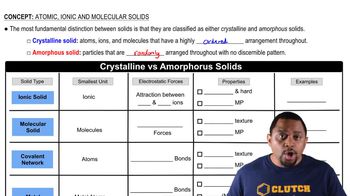
    Crystalline solids have highly ordered arrangements of particles, while amorphous solids have randomly arranged particles with no discernible pattern.
  • What type of bonding is responsible for the structure of metals in the solid state?
    Metals are held together by metallic bonds, which involve a pool of electrons shared among metal atoms.
  • Why are ionic solids typically brittle?
    Ionic solids are brittle because the strong electrostatic forces between cations and anions make the structure hard, but shifting layers can cause repulsion and break the solid.
  • Which property allows amorphous solids to behave differently from typical solids?
    Amorphous solids can flow, a property usually associated with liquids and gases, due to their lack of a fixed structure.
  • What is the smallest structural unit in molecular solids?
    The smallest unit in molecular solids is the molecule, which is held together by intermolecular forces.
  • Give an example of a metal that is soft and one that is hard, as mentioned in the lesson.
    Sodium is an example of a soft metal, while titanium is an example of a hard metal.