Band of Stability: Alpha Decay & Nuclear Fission definitions Flashcards
Band of Stability: Alpha Decay & Nuclear Fission definitions
You can tap to flip the card.
Control buttons has been changed to "navigation" mode.
1/15
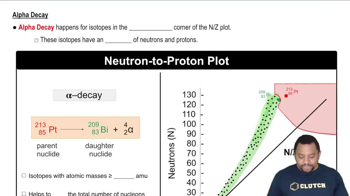
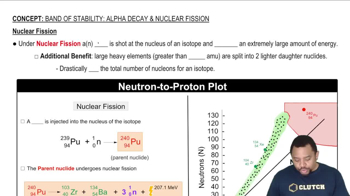
Radioactive IsotopesUnstable isotopes with an imbalance in neutron and proton numbers, often undergoing decay to achieve stability.Alpha DecayA process where an isotope emits an alpha particle to reduce nucleons and move towards stability.Nuclear FissionA reaction where an isotope is bombarded with a neutron, splitting into lighter nuclides and releasing energy.Band of StabilityA region on the neutron-to-proton plot where stable isotopes reside, with balanced neutron and proton numbers.Alpha ParticleA particle consisting of 2 protons and 2 neutrons, emitted during alpha decay.NeutronA subatomic particle with no charge, playing a key role in nuclear reactions like fission.ProtonA positively charged subatomic particle found in the nucleus, affecting an isotope's stability.NucleonsCollective term for protons and neutrons in an atomic nucleus.Chain ReactionA self-sustaining series of reactions where products initiate further reactions, common in fission.Daughter NuclidesStable isotopes produced from the decay or fission of a parent isotope.Mega Electron VoltsA unit of energy used to express the energy released in nuclear reactions.Neutron-to-Proton PlotA graph showing the relationship between neutrons and protons, indicating stability.Parent NuclideThe original unstable isotope that undergoes decay or fission to form daughter nuclides.Atomic Mass UnitA unit of mass used to express atomic and molecular weights, crucial in identifying isotopes.Electron CaptureA process where an inner orbital electron is captured by the nucleus, altering the isotope's stability.