Band of Stability: Electron Capture & Positron Emission definitions Flashcards
Band of Stability: Electron Capture & Positron Emission definitions
You can tap to flip the card.
Control buttons has been changed to "navigation" mode.
1/12
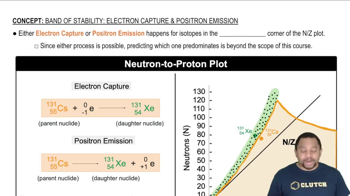
IsotopeAtoms of the same element with different numbers of neutrons, affecting nuclear stability.Neutron-to-Proton PlotA graph showing the ratio of neutrons to protons, used to determine nuclear stability.Electron CaptureA process where an inner orbital electron is absorbed by the nucleus, converting a proton into a neutron.Positron EmissionA decay process where a proton is converted into a neutron, releasing a positron.Valley of StabilityA region on the neutron-to-proton plot where isotopes are most stable.Cesium-131An isotope that can undergo electron capture or positron emission to become xenon-131.Xenon-131The daughter product formed from cesium-131 after electron capture or positron emission.ProtonA positively charged particle in the nucleus, whose excess can lead to instability.NeutronA neutral particle in the nucleus, whose increase can enhance nuclear stability.Daughter ProductThe resulting isotope after a nuclear decay process, such as electron capture or positron emission.Nuclear StabilityThe tendency of a nucleus to remain unchanged, influenced by neutron-to-proton ratio.Excess ProtonsA condition where an isotope has more protons than needed for stability, prompting decay.