Bond Angles quiz #1 Flashcards

Bond Angles quiz #1
Control buttons has been changed to "navigation" mode.
1/33
  • Why is the bond angle in a water molecule less than the bond angle in a methane molecule?
    Water has two lone pairs on the central oxygen atom, which increase electron repulsion and decrease the bond angle from the ideal tetrahedral angle of 109.5° (as in methane) to about 104.5°.
  • Which of the following species would you predict has the largest bond angle: NO2?
    NO2 has a bent geometry with one lone pair, so its bond angle is less than the ideal 120°. Among similar species, those with no lone pairs (like CO2) have the largest bond angle (180°).
  • What is the bond angle in an NH3 molecule?
    The bond angle in NH3 (ammonia) is approximately 107°, slightly less than the ideal tetrahedral angle due to one lone pair on nitrogen.
  • What are the bond angles in carbon dioxide (CO2)?
    CO2 is a linear molecule with a bond angle of 180°.
  • Which of the following bond angles is not present in this molecule?
    To answer, specify the molecule. Generally, a molecule's geometry determines which bond angles are present; for example, a tetrahedral molecule does not have 120° bond angles.
  • What is the value of the bond angle in XeF2?
    XeF2 has a linear geometry with a bond angle of 180°.
  • What is the value of the bond angle in XeCl2?
    XeCl2 also has a linear geometry with a bond angle of 180°.
  • What are the bond angles in a trigonal pyramidal geometry?
    Trigonal pyramidal geometry (like NH3) has bond angles slightly less than 109.5°, typically around 107°.
  • What is the angle of the bonds in NO3-?
    NO3- has a trigonal planar geometry with bond angles of approximately 120°.
  • What is the characteristic angle between atoms in a linear molecule?
    The characteristic bond angle in a linear molecule is 180°.
  • What is the value of the bond angle in ICl2-?
    ICl2- has a linear geometry with a bond angle of 180°.
  • What effect does the presence of lone-pair electrons have on the bond angles in a molecule?
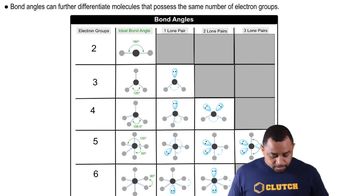
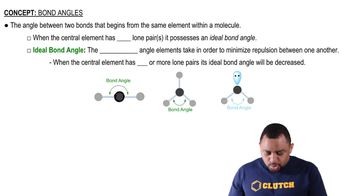
    Lone pairs increase electron repulsion, causing bond angles to decrease from their ideal values.
  • What is the bond angle in carbon dioxide (CO2)?
    The bond angle in CO2 is 180°.
  • What is the expected bond angle indicated in the molecule below?
    Without a specific molecule, the expected bond angle depends on its geometry: linear (180°), trigonal planar (120°), tetrahedral (109.5°), etc.
  • What is the value of the bond angles in BCl3?
    BCl3 has a trigonal planar geometry with bond angles of 120°.
  • What is the angle between the carbon-oxygen bonds in the carbon dioxide (CO2) molecule?
    The angle between the carbon-oxygen bonds in CO2 is 180°.
  • Which of the following has bond angles slightly less than 120°?
    Molecules with three electron groups and one lone pair, such as SO2, have bond angles slightly less than 120°.
  • What is the value of the smallest bond angle in XeCl4?
    XeCl4 has a square planar geometry with bond angles of 90°.
  • What is the angle of the bonds in CO3^2-?
    CO3^2- has a trigonal planar geometry with bond angles of approximately 120°.
  • What is the bond angle in an HCN molecule?
    HCN is linear, so the bond angle is 180°.
  • What is the bond angle in a BF3 molecule?
    BF3 has a trigonal planar geometry with bond angles of 120°.
  • What are the expected bond angles in ICl4+?
    ICl4+ has a square planar geometry with bond angles of 90°.
  • What are the approximate values of the bond angles labeled 1?
    Without a diagram, bond angles labeled '1' depend on the molecule's geometry: linear (180°), trigonal planar (120°), tetrahedral (109.5°), etc.
  • Which of the following correctly describes the bond angle in a molecule of the general type ABX?
    The bond angle in ABX depends on the number of electron groups and lone pairs: linear (180°), trigonal planar (120°), tetrahedral (109.5°), and decreases with lone pairs.
  • What is the value of the bond angles in COH2?
    COH2 (formaldehyde) has a trigonal planar geometry around carbon, with bond angles of approximately 120°.
  • What are the bond angles in ICl3?
    ICl3 has a T-shaped geometry with bond angles less than 90° and 180° due to lone pairs.
  • What is the value of the bond angles in COH2?
    COH2 (formaldehyde) has bond angles of approximately 120° around the central carbon atom.
  • Of the following species, which will have bond angles of 120°?
    Species with trigonal planar geometry, such as BF3, BCl3, and CO3^2-, have bond angles of 120°.
  • What are the bond angles found in germanium disulfide (GeS2)?
    GeS2 has a bent geometry with bond angles less than 120° due to lone pairs on germanium.
  • Select the correct value for the indicated bond angle in each of the compounds.
    Bond angles depend on molecular geometry: linear (180°), trigonal planar (120°), tetrahedral (109.5°), and decrease with lone pairs.
  • Based on the bond angles in CH4, NH3, and H2O, rank the magnitude of these repulsions.
    Repulsion increases with more lone pairs: CH4 (no lone pairs, 109.5°) < NH3 (one lone pair, 107°) < H2O (two lone pairs, 104.5°).
  • What are the bond angles in XeCl4?
    XeCl4 has a square planar geometry with bond angles of 90°.
  • Identify the approximate bond angles in each molecule.
    Approximate bond angles: linear (180°), trigonal planar (120°), tetrahedral (109.5°), trigonal bipyramidal (90°, 120°), octahedral (90°), and decrease with lone pairs.