Back

Borane Reactions quiz

Control buttons has been changed to "navigation" mode.
1/15
  • Why is boron considered electron deficient in its compounds?

    Boron has only three valence electrons and typically forms three bonds, so it does not fulfill the octet rule, making it electron deficient.
  • What is the general formula for borane?

    Borane is represented as BH3, with a boron atom bonded to three hydrogen atoms.
  • Why are boranes, such as diborane, highly reactive?

    Boranes are highly reactive due to their electron deficiency and inability to fulfill the octet rule.
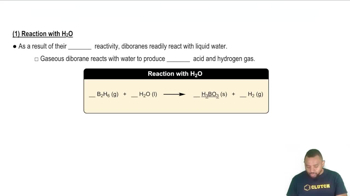
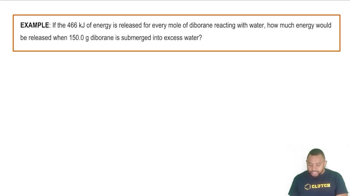
  • What is the product when diborane reacts with water?

    Diborane reacts with water to produce boric acid (H3BO3) and hydrogen gas (H2).
  • What are the balanced coefficients for the reaction of diborane with water?

    The balanced reaction is: 1 B2H6 + 6 H2O → 2 H3BO3 + 6 H2.
  • What is a Lewis acid in the context of borane chemistry?

    A Lewis acid is an electron pair acceptor, and boranes act as Lewis acids due to their electron deficiency.
  • Why can borane act as a Lewis acid?

    Borane can act as a Lewis acid because it has an incomplete octet and can accept an electron pair.
  • What is a Lewis base in the context of borane reactions?

    A Lewis base is an electron pair donor, such as ammonia, which can donate a lone pair to borane.
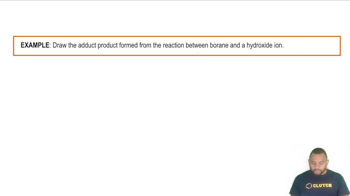
  • What happens when ammonia reacts with borane?

    Ammonia donates a lone pair to borane, forming a new bond and creating an adduct.
  • What is an adduct in Lewis acid-base chemistry?

    An adduct is the product formed when a Lewis acid and a Lewis base combine by sharing an electron pair.
  • What are the formal charges on nitrogen and boron in the borane-ammonia adduct?

    In the adduct, nitrogen has a formal charge of +1 and boron has a formal charge of -1.
  • Why is the overall charge of the borane-ammonia adduct neutral?

    The positive charge on nitrogen and the negative charge on boron cancel each other, resulting in a neutral molecule.
  • What is unique about the structure of diborane compared to simple boranes?

    Diborane contains bridging hydrogens, which is an unusual and highly reactive structure.
  • What drives the reactivity of borane and diborane compounds?

    Their high electron deficiency and inability to fulfill the octet rule drive their reactivity.
  • How does the concept of Lewis acids and bases relate to borane reactions?

    Boranes act as Lewis acids by accepting electron pairs from Lewis bases, forming adducts through new bonds.