Pearson+ LogoPearson+ Logo

Bronsted-Lowry Acids and Bases quiz #1 Flashcards

Back
Bronsted-Lowry Acids and Bases quiz #1
Control buttons has been changed to "navigation" mode.
1/11
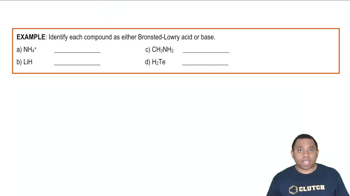
  • What is the conjugate acid of NH3 (ammonia)?

    The conjugate acid of NH3 is NH4+ (ammonium ion), formed when NH3 accepts a proton (H+).
  • What is the conjugate acid of SO4^2− (sulfate ion)?

    The conjugate acid of SO4^2− is HSO4− (hydrogen sulfate ion), formed when SO4^2− accepts a proton (H+).
  • What is the conjugate base of HI (hydroiodic acid)?

    The conjugate base of HI is I− (iodide ion), formed when HI donates a proton (H+).
  • What is the conjugate base of NH4+ (ammonium ion)?

    The conjugate base of NH4+ is NH3 (ammonia), formed when NH4+ donates a proton (H+).
  • What is the conjugate base of HCN (hydrocyanic acid)?

    The conjugate base of HCN is CN− (cyanide ion), formed when HCN donates a proton (H+).
  • What is the conjugate acid of HS− (hydrogen sulfide ion)?

    The conjugate acid of HS− is H2S (hydrogen sulfide), formed when HS− accepts a proton (H+).
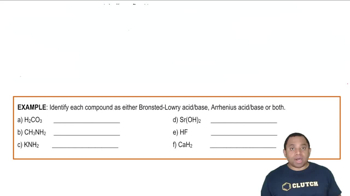
  • What is the Bronsted-Lowry definition of a base?

    A Bronsted-Lowry base is a substance that accepts a proton (H+).
  • What is the Bronsted-Lowry definition of an acid?

    A Bronsted-Lowry acid is a substance that donates a proton (H+).
  • What is the conjugate acid of H2O (water)?

    The conjugate acid of H2O is H3O+ (hydronium ion), formed when H2O accepts a proton (H+).
  • How do you identify an acid-conjugate base pair in a chemical reaction?

    An acid-conjugate base pair consists of two species that differ by one proton (H+); the acid donates a proton to form its conjugate base.
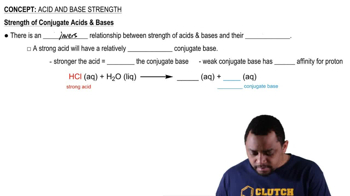
  • Describe the relationship between the strength of an acid and its conjugate base according to the Bronsted-Lowry theory.

    There is an inverse relationship: strong acids have weak conjugate bases, and weak acids have relatively strong conjugate bases.